Showing posts with label sports. Show all posts

Thursday, July 21, 2011

Native athletes show off their skills in 2011 Indigenous Games

Manny Boyle (left) and Raelyn Rodriguez (right, with her dad, Dennis) brought home medals from the 2011 Indigenous Games in Wisconsin.

Click here to see more photos from the Indigenous Games on our Facebook page.


Valley Center is known for its production of amazing athletic talent, and a few of our young local athletes got the chance to show off their skills in the 2011 Indigenous Games in Milwaukee, Wisconsin last week.
Manny Boyle, a junior at Valley Center High School, represented the San Pasqual tribe in the wrestling tournament and swept his opponents to bring home the gold medal in the 135-pound division.
“It was a really amazing experience,” Boyle says. “I knew it was a once-in-a-lifetime opportunity, so I went in focused on wrestling, and when I won, I was able to celebrate.”
In the softball tournament, Team California featured 15 players from six different tribes, including VCHS senior Raelyn Rodriguez, a member of the Rincon tribe, and 2010 VCHS graduate Olivia Hernandez, a member of the Pauma tribe. After suffering a tough loss to Wisconsin in the opening game, the team won its next four games before falling in the championship game to Wisconsin again.
“I felt so privileged and honored to represent California and my tribe against the best of the best,” Rodriguez says. “We had girls from different tribes and different towns, but we were able to set aside our differences and get along on the field.”
Boyle’s run to the gold medal included four wins in the tournament against opponents from Wisconsin, New Mexico and North Carolina. The only match he didn’t win by pin was the second match, which he won by major decision.
“It was harder than I expected going in,” he admits. “I noticed that their style was much slower than what you usually see in California. Our style is trickier and less aggressive, but I was able to pick up on it pretty quick and take on the pressure.”
The softball team also had to make some adjustments after losing the first game largely because of errors.
“The team from Wisconsin beat us in the first game because we had so many errors,” Rodriguez says. “After we gave up seven runs in the first inning, we knew we had to play so much better in the next game.”
The team rattled off four straight wins, then ran into Team Wisconsin again in the title game.
“We were tied at two through seven this time,” Rodriguez explains. “And in international rules, extra innings start with a runner on second. So their first batter dropped down a bunt, and our third baseman air-mailed it over the first baseman’s head, but we somehow kept the runner at third. We loaded the bases with a walk, and with one out, they hit a grounder that our shortstop threw over the first baseman’s head, and that was it.”
Despite some rough patches on defense, Rodriguez says that the team played well in some tight spots.
“It seemed like whenever we had two outs, or we really needed a run, someone would step up and start a rally,” she says. “We found ways to score runs and we got in a good rhythm. And our outfield knew where to throw the ball and knew what to do no matter what the situation.”
Rodriguez, the starting centerfielder for the Lady Jaguars varsity softball team this past season, came up with a few big plays herself.
“I don’t want to brag or anything, but I did so good!” she says with a laugh. “I drove in the two runs we scored [in the championship game], I scored six or seven runs and I made a couple of catches on balls in the gap. I was so proud!”
Both Boyle and Rodriguez say they were impressed with the quality of play they saw on display at the games, and they even picked up a few new things that should help them when the next school season rolls around.
“I want to be CIF champion and Master’s champion next year,” Boyle says. “And I just want to thank my coaches and my dad for all their support.”
“I thought that they would be easy to beat, but they’re legit,” Rodriguez says. “There were no easy teams, and they battled us every game. I noticed that I need to work on the little things. We didn’t get any batting practice while we were there, so I can’t wait to start working again.”
Thousands of athletes, primarily young people, participated in the competitions, making the U.S. Indigenous Games (USIG) the largest event to host competitions for young Native youth across Indian country. The U.S. Games take place every two years and Milwaukee was the launch site for Indigenous Games USA. The Games proved to be a showcase for Native youth to participate in individual competitions such as archery, track, boxing and wrestling. The team competitions such as baseball, basketball and a newly added competition of dodgeball are examples of the span of competitions. The games certainly proved to be a spectacular event for spectators and allowed Native and non-native people to watch the competition and learn about the cultural activities of tribal nations from across the United States.

Friday, July 15, 2011

Athlete of the Year: Coaches' Thoughts


Our 2011 Athlete of the Year, Kevin Murphy, has had a lot of different coaches in his life.
In his senior year at VCHS, Murphy had five different coaches from five different varsity sports, and they all had plenty of good things to say about such a versatile, hard-working athlete.
Here are their thoughts:

Kyle Kline, varsity boys water polo coach:
I think Kevin is a great choice for Athlete of the Year. I only had the pleasure of coaching Kevin for one season. I have had many athletes show up senior year and decide they want to play water polo and I was skeptical when I heard about Kevin and his desire to join the team. He showed up with confidence and I really didn’t expect him to last more than one day.
Kevin proved me wrong and exceeded my expectations. He was definitely behind on experience and conditioning in the water but that didn’t discourage him one bit. He worked through the tough practices and absorbed as much as he could to try to catch up. This is definitely one of the most coachable athletes I have had and he put everything I tried to teach him to use. I would only have to tell Kevin something once, and I would see him working on whatever it was throughout the rest of practice and the whole season. Kevin is also a natural athlete. He is aggressive and gives 110% with everything he does.
Something else that really defined Kevin was his willingness to face a tough challenge. He never backed down from a tough swim set that would give seasoned swimmers a tough time. What really set him apart was his decision to take on one of the toughest positions in the pool as two meter defense. This position involves defending usually the biggest and strongest player on the opposing team. When I described this position Kevin’s eyes lit up. He knew this was his spot and he wanted to make sure he earned the starting position. He worked hard and earned the starting spot and again exceeded my expectations. This position does not usually get the stats that the offensive two meter player gets. It does not get nearly as much attention or glory as other positions. Kevin was not in it for those things. He was in it for the challenge and to help his team. He handled athletes that had many more years experience than him and did an excellent job.
What makes Kevin a successful athlete is a combination of things. His work ethic is exceptional. He is confident but not over confident. He faces challenges head on and with an enthusiasm that I don’t often see. He is a positive role model for younger athletes and a team leader. He leads by example but is outspoken when necessary. He is extremely coachable and has a great attitude. All of these things are beneficial to a team. He made a huge contribution to my team this season and I can only imagine the water polo player he would have been with a few more years experience.
I am sure Kevin will apply these characteristics in the future and it is these that will ensure success in anything he chooses to pursue.
Kevin’s senior year stats: nine goals, 16 assists, 31 steals, and four blocks.
Thanks for giving recognition to a great athlete, student, and individual!

Clay Clifford, varsity wrestling coach:
Kevin was a three-year varsity letterman for wrestling and was a contributor to our second place finish at the San Diego CIF Division IV Championships. Kevin is good-natured and was a pleasure to have on the wrestling team. He made many sacrifices for the team when called upon, and always gave his best effort. I expect that Kevin will one day be a very good coach, hopefully in the sport of wrestling.

Rick Darland, varsity boys golf coach:
Kevin is a great kid and a team leader, and I had a lot of fun coaching him this season. To be able to do that many things that well shows you what kind of an athlete and what kind of a person he is.
Because of the nature of golf, you can’t just pick up your sticks after taking all winter off, but somehow Kevin showed up this spring and was better than he was last year. He progressed further than I thought he would this year.
He’s a well-rounded person who enjoys life, and he knows what it takes to be successful in whatever he wants to do.

Rob Gilster, varsity football coach:
He played football all four years, and he was thinking about just doing water polo his senior year, but he was such a strong long snapper that we found a way to make it work out for him to do both this year. He’s a really good long snapper, and I’m sure he could have helped us out at some other positions on the football field, but he was really passionate about water polo. He was able to get in some practice time and work with Davey [Last, the football team’s kicker] on his own. And he was able to get to all our games on time, even though he had other games on the same day.
He was also one of my ASB students this year, so I got to work closely with him on a lot of school activities. He’s a great kid, a hard worker, and very dependable. You know he’s going to get the job done.
He’s very responsible, and as a student and as a player, same thing. I know he had a lot of other responsibilities in his life, but he’s committed to doing what he needs to do to be a good teammate, a good student and a good person.
I think the balance and time management that he’s learned through sports and ASB in high school are important skills he will carry with him. That’s what so much of life is—we don’t always get to focus on just one thing, we have to be able to handle a lot at a time, and Kevin is definitely prepared to do that.
And he was good, too. He’s a great athlete.

Laura McCaulley, varsity swim coach:
Kevin did really well this year for the swim team. He fit in well with the boys and helped us out a lot, especially in the relays. He went to league for the 200 freestyle and 400 freestyle relays and got better throughout the year.
His experience with the water polo team helped him be successful because he was already training really hard. During the swim season, he would come to the morning workout because he had golf in the afternoon, so he had a lot of long days.
But it paid off because he did such a great job in the league finals, where he placed in both the relay events as well as the 200 freestyle.
He’s a really hard worker, and that’s only going to help him with whatever he does in life. His work ethic is unreal!

Thursday, April 14, 2011

VCHS spring sports photos

Be sure to check out our Facebook page for new galleries of photos from VCHS spring sports. We've got plenty of baseball and softball photos up now, and will have lacrosse, volleyball and golf coming shortly.

Click here to see the photo galleries.

And be sure to send us your sports photos, either by e-mail to sports@valleycenter.com or by uploading them on our Facebook page at www.facebook.com/valleycenter/

Wednesday, March 16, 2011

Local author examines how action sports changed the business world

BY: DAN KIDDER

What if the world had never heard of Tony Hawk?
Sure, there are those who would welcome the liberation of their precious sidewalks from the tyranny of an army of four-wheeled oppressors.
But for those who rocked DC gear before it was mainstream, who saved up to buy that Element deck they had their eye on, who saw Hawk pull off the 900 at the X-Games in 1999 and immediately went outside to practice on their own boards—and who know that Hawk’s popularity came about only because of the revolutionary pioneers of the sport, a list that includes Alan Gelfand, Tony Alva, Danny Way, Per Welinder, Andy Kessler and so many more—a life without a skateboard is unimaginable.
It staggers the mind to think about how a group of bored surfers who slapped some metal wheels on the bottom of a wooden box turned out to be the unwitting pioneers of a multi-billion dollar industry. But in the 60-odd years since these unknown street surfers first shredded the California concrete with their new invention, skateboarding has transformed from a weekend hobby into a unique, multi-layered culture.
How did it happen? How did these punks on wheels turn into multi-millionaires? How did the underground skaters in the Z-Boys and the Bones Brigade morph into international superstars? Why didn’t things like frisbee competitions, which were also on the fringe of popularity in the 1970s, explode into a worldwide phenomenon?
Basically, what was it about skateboarding that made it so cool?
That’s what Alex Striler wanted to know.
The Valley Center resident came to California from a job on Wall Street eight years ago and recently published the book X Play Nation, an examination of the people, companies and marketing strategies behind the surge in popularity of action sports.
“I came out here to run a company that sold to skaters online, and I thought I knew how to do it,” he says. “Boy, was I wrong. So I hooked up with Tony Alva, and he helped me see that it’s an entirely different culture than the business community is used to dealing with.”
From that realization came a desire to help create connections between the business community and the ever-growing nation of action sports.
“These endemic brands like DC Shoes just don’t understand the way that corporate America works,” Striler says. “And corporate America doesn’t understand the culture around these brands. This book is a way to bridge that gap.”
X Play Nation is an in-depth look at how leading action sports companies created their brands using lifestyle marketing. With more than 50 interviews of company founders, CEOs and professional athletes, Striler thoroughly examines the roots of skateboarding, the process and effectiveness of lifestyle marketing, the impact of technology and social media on the culture, and the current direction of the culture, including a chapter on the rise of action sports in China.
“My generation grew up with the traditional sports—baseball, football and basketball, or if you’re from Europe, hockey and soccer—and things like skateboarding and snowboarding were just weekend hobbies,” Striler says. “My kids are growing up not knowing the difference between action sports and traditional sports. They don’t view the X-Games as any different from Major League Baseball. My son Cole plays baseball, but he also knows about guys like Ken Block and Mike Metzger. These athletes are finding new ways to earn money by being good at their sport, winning competitions and getting sponsors. And this book is an explanation of how the industry works.”
It’s already working, too. Striler tells a quick story about Vox Footwear, a company formed by his friend, skater Ed Dominick, along with Dr. Chen, a traditional businessman who also helped found Osiris Shoes.
“They always fought about how to do business,” he says. “Doctor Chen came from a methodical business culture and wanted Ed to have regular hours, wear a tie and all of that. Ed was a skater, so he wanted to hit the skate park for lunch and things like that. Ed ended up leaving, saying that he just couldn’t handle that environment anymore. After he left, Doctor Chen got a copy of my book and invited me to lunch. He told me, ‘Thank you for this book, now I understand what Ed was trying to do.’ He called Ed and apologized for everything. Ed sent me a heartfelt e-mail saying that, after four years of an unbearable work environment, Doctor Chen’s call reconciled everything.”
One of the book’s chapters highlights the trend-forward nature of action sports in the parity between genders that pervades deeper into the roots of the sport than in any of the traditional sports.
“The support that was coming in for the guys, it just wasn’t happening for girls,” Striler says. “At the X-Games, the medals for men were something like ten thousand, but for girls it was only like eighteen hundred. The girls united and said that they should get as much as men because they’re out there getting the same exposure. That’s something you don’t see in other sports yet.”
Striler’s ultimate hope for this book is to make it possible for a company looking to support the next skating superstar to find the kid who is out on his sidewalk perfecting the next revolution in the sport.
“Action sports are about creativity and expression,” he says. “Anyone can increase the bar by doing something that no one else has ever done. That expression of creativity is what’s fueling the industry. It’s so innovative, I can’t wait to see what unfolds in the next five years.”
Check out X Play Nation on the book’s Web site at www.x-playnation.com or search for X Play Nation on Amazon.

Friday, February 18, 2011

Valley Center High School 2011 spring sports tryout schedule

Valley Center High School – Jaguar Athletics
Spring Tryout Schedules 2011


You must turn in a sports clearance form to the office before participating in tryouts. Also note that tryouts fall on our Presidents Break week off. Clearance packets must be turned in by Friday, February 18th. The next date that packets can be turned in is Monday, February 28th. Please plan ahead.


Baseball
Tuesday through Friday 2/22 to 2/25
2:305 p.m. on the varsity baseball fields

Boys Golf
Starting Monday 2/21
35:30 p.m. at Pauma Valley Country Club

Boys Lacrosse
Tuesday through Thursday 2/22 to 2/24
3:305:30 p.m. at the Primary School

Girls Lacrosse
Monday through Friday 2/21 to 2/25
35:30 p.m. at the Elementary School

Softball
Friday 2/25 from 25 p.m.
Saturday 2/26 from 9 a.m.noon

Swimming
Monday through Friday 2/21 to 2/25
35:30 p.m. at Adams Park

Boys Tennis
Wednesday to Friday 2/23 to 2/25
3:155:15 at Adams Park

Track & Field
Monday/Wednesday/Friday 2/21, 2/23, 2/25
810:30 a.m. at the track

Boys Volleyball
Saturday 2/19, Friday 2/25 and Saturday 2/26
810 a.m. in the gym

Note: Once practice begins, practices will be daily.
Each coach will distribute additional time schedules for the remainder of the season.

Wednesday, January 5, 2011

I Kid You Not: forget resolutions, what can sports do for us this year?

The beginning of a new year can serve as a reminder of the ever-changing nature of our world. The old is gone, the new has come.
And so many of us take this opportunity to take stock in our lives; to re-evaluate what’s important, to learn from the experiences of the past year, and, if possible, to make plans for improvement in the year to come.
This is not what I will be doing this year.
Operating under the assumption that I’m pretty great already, I’ve decided that the world should be making resolutions to make my life better.
Specifically, I’ve decided that the sports world should make a few changes.
A couple of years ago, I wrote a list of sports-related resolutions that I wanted to implement. I wanted to watch more games (which I’ve done), go to more games in person (also done),
...root for a team over an individual (sorry, Miami Dolphins players, but my fantasy football team did much better without any of you in my starting lineup), wear real eye black (which was confused for mascara by a scorekeeper in my coed softball league last year)
...and in general, have more fun with sports.
After months of introspection (or five minutes watching Sportscenter), it became clear that A) I’m pulling my weight around here, and B) the sports world is not.
So what should the world of sports do to better appease me?
I’m glad you asked.
1. Quality Over Quantity
512. 4,860. 2,460. Another 2,460. 36. Add those all together and you get 10,328.
That’s how many major sports competitions are held every year, just in the regular season. 512 NFL games, 4,860 MLB games, 2,460 games in both the NBA and NHL, and 36 NASCAR races. If we say that the average length of each of these contests is around three hours, that’s 30,984 hours of major sports action every single year.
There are only 8,766 hours in a year, so since many of these games are going on simultaneously, the number will be higher.
But my goodness, 30,984 hours of sports? I’m a big sports fan, but even that seems like a little bit too much time. Some games are fantastic, and more than worth the three-ish hours we put in. Others involve the Milwaukee Brewers, and shouldn’t be shown to small children.
I’ve written before about how the NFL has it right—one game per team per week, 16 games in the regular season, three weeks of playoffs, then the Super Bowl. Just enough to keep us interested, but not too much that we get bored. Because let’s face it, Americans get bored really easily. What used to be called multitasking a few years ago is now just called “tasking.” We watch TV while we eat. We talk on the phone while we drive (um… with a hands-free device, of course). We watch more TV while we… um… sleep.
I’m just as guilty as the next person. In our home, my wife and I have three TVs (one of which looks like this),
...four video game systems, two computers and three cell phones, two of which are “smart” phones. Not counting my collection of old Hardy Boys books (I’m a sucker for kitsch), our DVD collection outnumbers our book collection (not as much as it used to before I got married, at least). I recently chuckled to myself as I noticed another person watching TV, listening to an MP3 player and playing Mario Kart on the computer, all at the same time. Needless to say, we live in a country that takes sensory input to levels never before imagined.
But as we discussed in the NFL-has-it-right column, more is definitely not always better. Baseball is fun to watch, but it’s easy to lose interest in a team when you can’t watch 162 games. Same with the NBA, NHL and NASCAR (as much as I love NASCAR, it’s just too long of a season). And now the NFL is talking about an 18-game schedule for next year. Really? I mean, I know football is America’s current pastime, but as ESPN.com writer Gregg Easterbrook consistently reminds us, there is no law that says football has to remain popular.
I know it’s a lot to ask, but I think the sports world owes us less quantity and more quality. If it means contracting a few teams in the NBA and NHL and scaling back to 40 games or so (from December through March or something like that), then let’s do it. If it means only playing baseball in the summer (the horror!) instead of spring-to-winter, then let’s whittle the schedule down to June, July and August, with the playoffs in September. If it means only running NASCAR races from February through August, so as not to overlap the NFL, I’m all for it.
Basically, I want to be able to enjoy the sports I get to watch. I want games to mean something. I want each sport to have its own season of the year, with the exception of basketball, which is boring and should be ignored while we watch hockey.
I want sports to be worth watching in the 8,766 hours I have this year.
2. More Football!
I know, this one seems to contradict the last one, but really, when you think about it… OK so it contradicts the last one. This is my wish list so I can contradict whatever I want.
I know it’s a long shot, but I’d really like to see steps toward the implementation of a Minor League Football system.
I outlined this idea in depth back in August—basically, you take the 32 NFL teams, give each of them a minor league affiliate in a nearby city, and have the minor league team supplement the NFL team’s roster when necessary. Wow, that was much easier to explain this time around. Makes me wonder why I needed 1,100 words to discuss it last time around.
I guess it was to talk about the details of how it would work, not to mention to suggest some fun names for the minor league affiliates (admit it, you’d go see a team called the Escondido Spark Plugs or the Fort Lauderdale Manatees).
This time, I’d like to focus on how it would make being a sports fan better. We all like football, because this is America, and if you don’t, well… you might be a communist. Just saying.
So how could more football not be a good idea?
The risk, as we touched on in the last section, is over-saturation. Too much football could make it seem ho-hum and watered-down.
But the potential reward is intriguing. If each NFL team had a farm team it could use to groom young players, the quality of play in the NFL would go up because young players would get more game experience in the minor league before getting shoved into NFL action. Players who were stars in college would get to quickly show whether or not they belong in the big leagues, while scrappy players who weren’t highly drafted would have more shots to show how their hard work has paid off. And it would even give players returning from injury a chance to play a real game as a bit of a warm-up to coming back to the NFL.
From a fan’s perspective, Minor League Football would give us more opportunities to watch professional-caliber football, play more (or different types of) fantasy football, buy more gear, attend more games (hopefully with the fun-first atmosphere of Minor League Baseball) and see more young players play in real games.
3. Cleaning House
If the world of sports really wants to appease the fans, the key is quality. And the best way to ensure that a quality product hits the field, court, rink or track is by increasing the level of competition while limiting the number of spots available to elite athletes.
In the case of professional sports, I really like the format of the English Premiere League, in which soccer teams are relegated to a lower league if they finish in the bottom four spots in the standings at the end of the season.
For the four major American sports, this would mean splitting the leagues into two levels and allowing only the teams in the top level to compete for the major league championship. In the case of the NFL, if we were to take the top 16 teams in the league (by record) and split them in half, we could separate the teams who are good from the teams who are not. We would have good teams facing good teams on a regular basis, and we wouldn’t have to sit through blowouts like we saw between the Steelers and the Browns on Sunday. Seriously, Cleveland? 41–9? Is that whole LeBron thing still getting to you?
Some might argue that this idea is flawed because we would still have to watch games like the Cardinals against the 49ers. That is true; terrible teams would still be terrible. We can’t get around that. But at least the terrible teams would only be playing other terrible teams, and they would be playing for some sort of second-rate championship, not to mention the chance to move up to the big leagues and play for the real title.
If we don’t get relegation, I’d at least like to see some form of contraction, especially in the NHL. I really like hockey, but there are 30 teams in the NHL, and I don’t think I can name more than one or two players on most of them anymore. And that’s kind of a shame since hockey names are pretty much the best. Where else can you find a guy named Guillaume Latendresse or Georges Laraque or Radek Bonk? Probably not even in the NHL anymore since it’s pretty well impossible to find a hockey game on TV these days.
But if the league went back to 15 teams (half of its current number)—preferably in the colder regions of North America— to consolidate talent, then slashed the schedule down to one or two games per team per week, it would make each game more important and full of better talent. And that’s the goal of this whole thing—more important games with more talent.
4. More Gus Johnson
Pro sports commentators are a dying breed.
Well, we’re losing most of the good ones, anyway. Pat Summerall was an icon. Keith Jackson made a highlight out of introducing the starting lineups. Dick Enberg and his trademark “Oh my!” provided so many great moments.
Bob Papa and Matt Millen, however, do not fall into this category. The NFL Network commentators are just two of the host of insufferable game callers who are increasingly harder to stomach. They all use too many clichéd catchphrases (“When you talk about the Chargers, you talk about a team that really plays well in December.”), too many incorrect words (it’s not, “They’re having a tough time figuring out how to defense the pass,” the correct phrase is, “They’re having a tough time figuring out how to defend the pass.” Don’t try to get all fancy on us.), and too many weird versions of common phrases that nobody else seems to be using (as in, when did “hand-eye coordination” become “eye-hand coordination?”).
At least we have Gus Johnson.

The CBS play-by-play guy has developed a reputation this season for calling the NFL games with the most thrilling finishes. He called the Jaguars/Texans game that ended with a Hail Mary touchdown on the final play and inspired ESPN.com writer Bill Simmons to incorporate Johnson into his many theories about how to predict the winner in NFL games. He’s even the commentator on Madden 11, which is a huge upgrade from Tom Hammond in the 2010 version of the game.
If we cut back on the length of the various sports’ seasons, then we can get Johnson calling games year round. And if that doesn’t make sports more enjoyable, then I don’t know what will.
But maybe you do.
If you have any ideas about what the sports world can do to make 2011 better for us, the fans, send them to me at sports@valleycenter.com and I’ll share them with our readers. You can send an itemized list, a couple of ideas, or just random scribblings on a napkin. Whatever you’ve got, send it in and we’ll do our best to make 2011 a great year for sports.

Thursday, November 4, 2010

Keeping young athletes safe and healthy is a passion for VCHS athletic trainer


Valley Center High School’s sports teams have a reputation of being competitive, well-coached and organized, and the athletes who play for the Jaguars usually find that they are better prepared for success in life because of the experience.
A key member of the VCHS athletic department is trainer Akiko Yoshiyama, or as she is known to the students, Aki.
Aki hails from Otsu City, Japan, a town northeast of Osaka. She came to the United States ten years ago to go to school and pursue a career in sports medicine.
“I wanted to be an athletic trainer, and this is the only country that licenses athletic trainers, so I pretty much had to come here,” she says with a laugh.
Since she spoke very little English before coming to America, Aki says it was difficult to learn the language at first.
“When I first got here, I lived with an American family, and it almost forced me to have to use English every day,” she says. “But that was good because I got to hear it more, so I was able to memorize it and learn to speak it.”
Aki went to Mira Mesa College at first, then transferred to San Diego State, where she graduated in 2005. She started at VCHS in the summer of 2006, and says she enjoys being a part of our community.
“I like it here,” she says. “Well, I don’t really know about the weather—it gets pretty hot up here. But I really like the people—the students, the coaches, the teachers. And it’s nice when you live in San Diego, you don’t get to see the country that much.”
As for working with high school athletes, Aki says that she experienced working for a professional sports team at first, but found that it wasn’t something she wanted to pursue.
“I had an internship with the Padres in 2005, but I figured out that working in the pros is really not the place for me,” she says. “For one thing, it’s very rare for a pro team to have a female trainer. The only one I know of is the Pittsburgh Steelers, who have a female trainer from Japan. But also, I felt that when I was working for a pro team, I only did what they wanted me to do. And there’s a lot to worry about besides just doing my job.”
At VCHS, Aki is on hand for games and practices every day that the school teams are in action.
“It depends on the day, but when football’s in season, I go to their practices every day,” she says. “But otherwise, I’m in my office, or I walk around to the different practices. All the coaches have my cell phone number, or they can get ahold of me on the radio. I’m always available to whichever team needs me.”
Aki also says she’s a big sports fan, especially of the NFL and the NBA. Remarking on the NFL’s recent focus on the issue of concussions, she says that it’s of utmost importance to take head injuries seriously, especially when dealing with high school students.
“High school athletes are more prone to concussions than NFL players because they’re still young and their brains aren’t fully developed,” she says. “Another reason is that younger players don’t have the same neck strength—it’s like whiplash, and they’re not able to tighten the neck muscles as well. I try to work with our athletes to strengthen their neck muscles and to use their mouth guards. Those two things will help prevent a lot of concussions.”
In the midst of the NFL’s increased attention on concussions, the league has more strictly enforced the existing rules designed to prevent helmet-to-helmet hits, and has created new rules to prevent further injury when a player has or is suspected of having a concussion.
Aki says that the rules in high school football are strict when it comes to players with suspected concussions, but she takes the precautions a step further.
“In high school, if a player is even suspected of having a concussion, he’s not allowed to go back into the game or practice for the rest of that day, and he must be cleared by a medical doctor before he can return,” she says. “My rules are a little more strict. I pull him out and tell his parents to get him to the doctor, and he has to sit out the rest of that day, but even after he’s cleared by the doctor, I test them with some basic physical tests before I let them get back in there.”
One way that pro sports teams and collegiate athletic programs are able to properly diagnose a concussion is by using baseline testing, which tests the basic motor functions of each athlete before the season, then uses those results to compare with a similar test given to an athlete suspected of having a concussion.
Aki says that baseline testing is effective when possible, but at the high school level, she has to find creative ways of monitoring a student-athlete’s normal motor function.
“It’s hard for high schools to afford [baseline testing], and even if we could afford it, I’m the only one here, so it would be hard for me to do all the tests for every athlete we have,” she says. “But when we have a kid with a possible concussion, I talk to his coaches, I talk to his teammates, and I talk to his friends to see if he’s acting weird or if everything looks normal. Sometimes a behavior will look weird to me, but if he’s like that all the time, then I can find that out from the people who know him.”
Aki adds that the athletes and coaches at VCHS are exemplary when it comes to being aware and taking care of the long-term well-being of the players.
“Our coaches have a good understanding of concussions, and they don’t argue with me,” she says. “Just to make sure they know what’s at stake, I like to scare them a little bit, you know, and it’s the same with the players. I’ll say, ‘This is your life on the line,’ or something like that, just to let them know that it’s about more than just this game.”
And the players respect Aki’s word as their trainer, according to football player Zach Blanco.
“She’s the toughest trainer I’ve seen,” he says. “She doesn’t let you get away with anything. She always says, ‘If you can play on it, then play on it,’ but she knows if it’s serious, and her word is final. She’s one of the best trainers in the league.”
Aki has a cousin named Yoko who lives in San Francisco, but the rest of her family is back in Japan, including her dad, Mamoru; her mom, Noriko; her older sister, Masako; and her younger sister, Yasuko.
Along with watching sports, Aki enjoys going skiing, a favorite activity of hers since she was three years old.
“I love to go skiing when I have the time,” she says. “I started when I was three years old, and my first pair of skis was plastic and about a foot long. It’s probably my favorite thing to do in my time off, but unfortunately, it’s also probably the most expensive.”
You can see Aki in action at most of the Jaguars’ home games throughout the various sports seasons, especially on the sideline during the football games. This Friday, the Jaguars play at Del Norte at 7 p.m.

Thursday, September 30, 2010

RUSH Offers Middle School Field Hockey Program

Rush Field Hockey will host a series of middle school training sessions this fall in Del Mar.
Valley Center varsity field hockey coach Katy Moyneur hopes that Valley Center’s middle school field hockey athletes will consider attending.
“I’d love to get more middle schoolers involved in field hockey,” she says. “The focus of the program is on skill development, proper technique, confidence and match play, and the skills the athletes will learn will prepare them not only for middle school games, but even up into high school and beyond.”
The middle school training sessions take place on Mondays and Wednesdays from 6–7 p.m. in October and November. The first session is set for Oct. 11 and the final session is Nov. 10.
The program will be held at the Hot Shotz Sports Center at the Del Mar Fairgrounds. The cost is $195 for five sessions. All participants must be a Rush member before signing up. Rush memberships cover liability insurance and are valid for all 2010 Rush programs.
For more information, visit the Web site at www.rushfieldhockey.org/middle-school-training-sessions/ or contact Coach Moyneur by e-mail at moyneur.ka@vcpusd.k12.ca.us

Thursday, August 19, 2010

I Kid You Not: Fantasy Football Sleepers & Snoozers 2010

You love football, I love football, and in less than a month, we’ll all be happy campers once again.
But for those of us who can’t get enough of the NFL with just the weekly games, there is fantasy football.
Although some may call it a fake sport, or just another way for nerds to crunch numbers, you can’t argue with the stats. Depending on where you get your stats, anywhere from 23 to 29 million Americans play fantasy football every year, and if you’re one of them, you know why.
The thrill of competition, the feeling of being involved with the players on your team, the simple joy of a T.J. Houshmandzadeh touchdown catch to help you beat Larry from accounting—it’s all just a part of the wonderful package.
If you’ve played fantasy football before, then you know how many opinions are out there masquerading as facts, telling you why a certain player is doomed to fail this season, or why you should avoid a certain player because it’s a surefire guarantee that he’s not going to make it through the season healthy.
If you’re new to fantasy football, it can seem a little overwhelming. But if you’re a veteran of the fantasy world, then you know how to take in all this raw data and form your own educated opinions, which are hopefully turned into beneficial decisions.
If you’re really good, you might start to express your own opinions to those around you. And since I’m one of those guys, I’m going to tell you who I think are some players with solid potential (sleepers) and who are guys I wouldn’t really want on my team (snoozers) for this season.
If you want hard data on these guys, there is no shortage of places to go to find what you’re looking for. The following is nothing more than one man’s opinion. Granted, one incredibly awesome, gifted, never-finished-worse-than-third-in-at-least-one-of-my-fantasy-leagues-since-I-started-playing kind of guy. But still—opinions they are.
With no further ado, let’s look at some players to snag and some players to avoid in fantasy football this year.

Sleepers

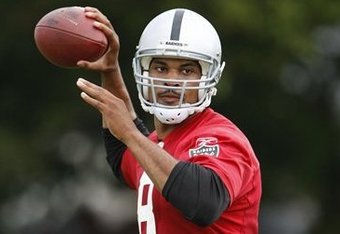
QB: Jason Campbell, Oakland Raiders
I know—the Raiders, you ask? Let’s just say that no team is going to look good when Jamarcus “That’s No Moon, That’s Our Quarterback” Russell...
...is overthrowing your receivers by 15 yards. Campbell is an accurate passer who brings confidence to an offense with some talent, but was mired in the cold, slippery grip of incompetence the past few seasons. They’re not going to win the Super Bowl, but Campbell will put up solid numbers all season.

Matthew Stafford, Detroit Lions
We saw some glimpses of Stafford’s ability and toughness last season, when he led the Lions to a last-minute victory over the Browns with an outstanding two-minute drive, shaking off a shoulder injury to re-enter on the final play and throw a touchdown pass that won the game. He’s still got his primary target, Calvin Johnson, as well as some new, potentially exciting talent on offense. I’m not saying he’s going to win the MVP, but if you still need a quarterback and he’s there in the late rounds, you could do a whole lot worse (see Jackson, Tarvaris).

RB: Ronnie Brown, Miami Dolphins
I’m a little biased here since I’m a Dolphins fan, but Brown has been a top-three fantasy running back at some point in each of the past four seasons. The reason he’s so commonly overlooked is because he was only able to finish one of the past four seasons, due to various injuries. Now, I can’t claim to know what will happen in the future. Well, I can claim that, but most of you would probably not believe me. Anyway, there’s a chance he could get hurt. But there’s a chance any player could get hurt, and Brown’s injuries were kind of fluky: a broken hand from a collision with an opponent’s helmet (2006), a torn ACL in his knee while making a tackle on an interception (2007), and a Lisfranc fracture in his right foot (2009). The ACL tear is a bit concerning, but he’s now gone two full seasons without any problems there, so why is there so much doubt that he will be healthy this year, any more than any other player? For fantasy purposes, you look at the potential cost/benefit analysis. Potential reward, you draft a top-ten fantasy running back (maybe better) with a fourth-round pick. Potential cost, he gets hurt and your fourth-round pick goes down the drain. To me, that’s not a huge risk. I mean, who else are you going to grab in that spot, Justin Forsett (who isn’t even the starter) or Jerome Harrison (of the Cleveland Browns… let me repeat that—THE CLEVELAND BROWNS)? Why not take a chance on a guy who has the talent and the opportunity to be an elite back?

Cadillac Williams, Tampa Bay Buccaneers
This one is for the late rounds, because I don’t really think anybody from the Tampa offense will be that great. But despite the seeming committee in the Buccaneer backfield, Caddy showed some promise at the end of last season after coming back from a torn patellar tendon the year before. He was outstanding in his rookie season (2005) and is just now finally coming all the way back from that injury. Instead of stocking up on kickers, I’d be willing to give Cadillac a test drive (note: I’m pretty sure this is the only time anyone has ever used that joke. Ever. Pretty sure.)

WR: Chris Chambers, Kansas City Chiefs
Look, there isn’t much to get excited about when you look at the Chiefs this year. Until last year, their quarterback made a living watching other (or rather, more talented) quarterbacks win football games—Matt Cassel was the backup to Carson Palmer and Matt Leinart at USC, then spent four seasons as Tom Brady’s designated baseball cap holder in New England. Their running backs either have some pretty good potential (Jamaal Charles and Dexter McCluster) or might be running out of gas (Thomas Jones). The offensive line isn’t great either, but word is that it might be getting better—emphasis on “might.”
Their receivers aren’t much to look at either, but one thing we learned from the last half of 2009 was that Cassel somehow developed a rapport with Chambers, the number two wideout on the depth chart this year since Dwayne Bowe is pretty solidly established as the primary target.
Now I’m not saying that the Chiefs’ passing game is going to be electric, but I am saying that there seemed to be a connection between Cassel and Chambers last season, especially down the stretch—you know, when fantasy football match-ups are kind of important. If he’s still around in the later rounds, he’s probably going to be a good deal.

Josh Morgan, San Francisco 49ers
Pretty much, what I said about Chambers, apply that to Morgan. Also, Morgan is younger and his quarterback actually played in college.

Derrick Mason, Baltimore Ravens
Everybody’s all ga-ga for Anquan Boldin, and with good reason. But in my opinion, all his arrival does is open up more opportunities for Mason, who is as sure-handed as any number two receiver out there. The Ravens have a pretty exciting offense this year, and the way Ray Rice runs, you know there will be open spots for Mason in the secondary. Again, I don’t think he’s good enough to be your number one WR or anything, but if he’s there in the sixth or seventh round, I think you’ll do fine with him.

TE: Jermichael Finley, Green Bay Packers
Everybody thinks that Aaron Rodgers is going to have a monster year, and I agree. Finley is young, big, fast, and has great hands. He’s going to gobble up touchdown after touchdown this season.

Snoozers

QB: Donovan McNabb, Washington Redskins
McNabb is a tough place to start with the snoozers, because I don’t mean to imply that he’s going to be worthless. I just don’t think he’s going to put up the kinds of consistent fantasy numbers that he did last year with the Eagles. It’s a different system, he’s got new receivers to work with, and the ‘Skins actually run the ball from time to time. McNabb will end up with a decent season, I’d wager, but probably nothing significantly higher than Jason Campbell’s season totals for Washington last year. Basically, McNabb isn’t going to be as good as he was last year, so I would just be careful how high you rank him.

Carson Palmer, Cincinnati Bengals
Like Rodgers, a lot of people think Palmer will have a big year. He’s got the Ochocinco/Owens circus to ringlead, a (supposedly) talented rookie tight end, and a healthy Cedric Benson carrying the load. It looks really good on paper.
But they don’t play games on paper, probably because that would be a waste of paper, and it’s much easier to just play the game on your computer like the rest of us. Anyway, this is purely a gut thing, but I don’t think Palmer will be all that valuable come season’s end. He’ll have his days, I’m sure, but he plays some tough defenses (Pittsburgh and Baltimore twice each, New England, Atlanta, San Diego and the New York Jets among them) and he hasn’t really been all that great the past few seasons. I don’t think that another narcissist wide receiver in the locker room is going to help his demeanor much.

RB: C.J. Spiller, Buffalo Bills
He looks like he’s got lots of potential right now—good speed, an offense committed to the run, and the other two potential starting running backs (Fred Jackson and Marshawn Lynch) have picked up some minor injuries in the preseason.
But one of my new favorite words for this season—“meritocracy”—comes into play here. Jackson led the team in rushing last season, and Lynch is still a big, physical back who can pick up tough yards. Spiller may have talent, but in the NFL, the ball goes to the guys who earn it. Until Jackson and Lynch completely blow it out there, I feel like Spiller is doomed to a few chances here and there, at best.

Joseph Addai, Indianapolis Colts
He’s getting older, he plays on a team that doesn’t run very much, and he’s got a younger guy (Donald Brown) behind him who, according to the “insiders” who seem to know these things, is going to get more chances this year. Even if Addai gets the bulk of the Colts’ carries, he hasn’t really done much with them the past few years.

WR: Chad Ochocinco, Cincinnati Bengals
Read what I wrote about Carson Palmer again. Then add to it the fact that Ochocinco A) isn’t getting any younger (or faster), B) clearly doesn’t like sharing the spotlight, and C) gets easily frustrated when things aren’t going well. The Bengals play at New England to open the season, then host the Ravens in week two. I can’t imagine them winning either of those games, much less both. It could be a rough year in that locker room.

Miles Austin, Dallas Cowboys
This one is similar to McNabb in that I’m not saying Austin will be terrible—I just think that all the hype has gotten a little out of hand. The Cowboys played well and Austin got a lot of points last year, but defenses kind of know he’s coming this year. Chances are he’ll get taken really early, and chances are, the guy (or girl) who drafted him in your league will end up just a little disappointed.

Any Receivers From The Pittsburgh Steelers
(like Mike Wallace...)
(oops, wrong Mike Wallace...um...here we go...)
Ben Roethlisberger is out for six weeks, and Byron Leftwich is no longer the same dude that got carried by his offensive linemen to run the two-minute drill at Marshall. Super Bowl MVP Santonio Holmes is gone, Hines Ward is still good but getting old, and I’m not entirely convinced that Mike Wallace (no, not the guy from 60 Minutes) can be considered elite. It’s not like they’ll be terrible, but for where they’re going in mock drafts right now, there are better guys out there.

TE: Greg Olsen, Chicago Bears
His quarterback likes throwing it to the other team, he’s got a much older guy pushing him for the starting spot (Desmond Clark), and his new offensive coordinator doesn’t really do much to get the tight end involved anyway. Yeah, you remember the Rams from the late 1990s, with Mike Martz as the offensive coordinator? The guy who helped make Kurt Warner, Isaac Bruce, Torry Holt and Marshall Faulk into superstars? Can you name the tight end from the 1999 Rams? It was this guy. In 16 games, he had all of 25 receptions. Not exactly lighting up the fantasy scoreboard.
— — —
There you have it, the official I Kid You Not sleepers and snoozers. Take this advice, go forth, and dominate your league.
Or wonder whether or not I gave you a bunch of false leads just to throw off any of the other owners in my league who might be reading this column. Maybe I’m giving good advice, or maybe I’m watching out for my own interests. I will let you decide.

VCHS Fund-raiser Mattress Sale This Weekend


On Saturday and Sunday August 21st/22nd, 2010, our Valley Center High School Athletic Programs are pleased to host a one of a kind fundraising event. This event has been VERY successful in school districts all across the country over the last 4 ½ years and we now have the opportunity to run this event here at Valley Center!
I am sending this brief note home as a gentle reminder. If you think you might be in need of a mattress (or mattress set etc.). Or, if you know of any family or friends that might be in need. PLEASE keep Saturday & Sunday August 21st/22nd, 2010 open!
The mattress sale will be at the Valley Center High School.
There will be 15-20 sets on display to try out and a team of experts to answer any question you might have. No pressure. Just savings to our community from 30-60% below retail. Mattress sets will all have direct factory warranties just like the stores. All beds our quality name brands with most even being Consumer Digest Best Buys !!
All we ask is you just come in and take a look. It is a pleasure to be able to find a way to help our students and their families while providing cost savings to our community.
We would very much appreciate your support of our fundraiser. I hope that you would be able to spread the word to neighbors, families and friends.
See you on Saturday or Sunday August 21st or 22nd, 2010!

Tuesday, August 3, 2010

VCHS Fall Tryouts Schedule

Valley Center High School – Jaguar Athletics
Fall Tryout Schedule 2010

You must turn in a sports clearance form to the office before participating in tryouts!

Boys/Girls Cross Country
Starting, Monday, August 16th 6:30am-8:30am at the track

Girls Field Hockey
Starting Monday, August 16th 7:00-10:00am
At grass field hockey field/JV baseball field

JV/Varsity Football
Thursday, August 12th pick up gear: Var /9:00am JV /9:30am Practice 3:00-5:00pm
Friday, August 13th: 8:00-11:00am and 2:00- 5:00pm
Saturday, August 14th 8:00-10:00am

Frosh Football
Thursday, August 12th pick up gear: 10:00am 11:30-1:30PM
Practice Friday, August 13th 8:00-12 noon
Saturday, August 14th 8:00-10am

Girls Golf
August 16th-19th _ All levels 9:00-10:30am at Woods Valley Golf Course
August 23rd and 24th 3:00-5:00pm

Girls Tennis
Starting Monday, August 16th 3:00-5:00pm at Adams Park

Girls Volleyball
Monday, August 16th – All Levels 3:00-6:00pm in VCHS gym
Tues-Thurs, August 17th-19th Frosh 2:00-4:00pm Var/JV 4:00-6:30pm

Boys Water Polo
Starting Monday, August 16th at Adams Park
Varsity: 6:00-7:30am and 4:00-6:00pm
JV/Novice: 6:00-8:00pm

Note: Once practice begins, practices will be daily.
Each coach will distribute additional time schedules for the remainder of the season.

Note: All athletes must be cleared before they can tryout for a team.

Athletic Clearance Packets are available at the VCHS front office starting August 2nd. A printable version of the packet is available on the Valley Center High School web site. Completed packets that contain proof of a recent physical, proof of insurance, all signatures signed, and all information filled out must be turned into the athletic director’s office before an athlete can try out for a team.
There will be a Sports Clearance Night at the high school on Monday, August 10th, starting at 6:00 pm. Cost is $30 for a physical. Parents must attend physical night with their son/daughter. You may get a physical from another doctor, but you must use the form that is in the clearance packet.

Tuesday, June 29, 2010

Inaugural Inter Tribal Sports Tournament to Tee Off on July 12

Golfers are invited to tee off at the inaugural Inter Tribal Sports (ITS) Golf Tournament that is open to the public at Journey at Pechanga on Monday, July 12.
Participants will play on the world-class course while raising money for ITS, a dynamic non-profit organization that unifies tribal youth and communities through structured athletic programs. The four-person scramble tournament begins with a shotgun start at 8 a.m. and will feature great food, tee prizes, a raffle and golf contests. The cost is $165 per person. Hole sponsorships are also available.
ITS provides a safe environment for young athletes to build self esteem, respect one another and learn sportsmanship while developing athletic skills guided by community volunteers, recreation professionals and educators. Recently, ITS was recognized by NIKE when the organization was awarded with a grant from the Nike N7 fund, a grant created to unleash the potential of Native American youths through the power of sport. There are currently fourteen different tribal communities in Southern California participating in Inter Tribal Sports programs. Sponsors of the Inter Tribal Sports organization include the Barona Band of Mission Indians, Pauma Band of Luiseno Indians, Pechanga Band of Luiseno Indians, the Southern California Tribal Chairmen's Association, Soboba Band of Luiseno Indians, Sycuan Band of the Kumeyaay Nation and Mesa Grande Band of Mission Indians along with Strictly Native Apparel. For more information or to register for the event, visit www.intertribalsports.org or call the ITS office at 951-695-0909.

Reader Response: Thoughts On The World Cup

Hey Dan - enjoyed your article in the Roadrunner regarding the World Cup. As I was reading it some thoughts came to mind:

1. Since there are so many diverse nations represented at the WC, what language are the players speaking when their talking to (a) the ref (b) the opponent? For instance, Japan is playing against, say, Mexico, and the ref is from England. Ok, so as the Japanese player is complaining/shouting to the ref about the Mexican player and vice versa, what the heck language are they speaking to each other? Same when I see the ref talking to players...warning them to stop pushing or something...or even at the start during the coin toss...does the German ref say "heads or tails"...does the Spanish player respond "heads"/"tails"...must be quite a funny scenario.

2. Will the vuvuzelas (loud, obnoxious horns) infect American sports? The closest thing I know of is in Minnesota and the Viking fans. I think they have a loud vuvuzela type of horn they blow there. Hope it doesn't spread to other sports/cities here in the USA. Maybe vuvuzelas can be banned at the customs...no one allowed to bring it in to the country. Did you know that the vuvuzela is banned from Yankee Stadium?

3. Here's something I've always wondered. In the USA we call the sport "soccer", while the rest of the world calls it "futbol". And, as we know, "soccer" is a relatively new sport in the USA...ok with that said, who's the wise-guy that came up with the name "soccer"? And where did the word come from? And why that name? And what does it mean? Seems like our own football is misnamed. Our football is mostly carried in our hands/arms. On few occassions during a game is the foot used (kick-offs, punts, PAT's, field goals)...otherwise most of the time we use our hands...yet we call the sport football. Let's see if I have this right...baseball has bases...handball uses the hand...basketball we throw the ball into a basket...racketball we use rackets...track & field is held on a track and field...volleyball you volley a ball...and football you hardly ever use your foot...huh? Should it be renamed to something like "tackleball" since almost every play involves tackling? Seems like the word "football" aligns better with the sport of soccer/futbol since most of the time the ball is kicked by the foot!

4. Will instant replay (IR) be used in high level soccer (er, futbol) tournaments like the Euro-Cup, or WC, etc. Maybe have a 5th official "in the booth" that can help the center-ref get it right on certain circumstances...like an obvious handball in the penalty box...or an obvious "offsides". The IR would only be available for the refs...no red flag like the NFL. I've told my wife that I don't think this will happen because socc...er, futbol is like baseball...lots of tradition, and very much a subjective sport. Like umps...each one has a different idea where the strike-zone is. However, baseball does use IR for fair/foul balls, homeruns, etc...maybe s...er, futbol could have a very limited use of IR too, like baseball.

5. If soccer is such a popular sport here in the USA at the youth levels, and its growing more at the adult levels, why has it not really caught on at the professional level? I suspect the main reason is commercials! All other popular USA sports are packed w/TV commercials (aka money)...however, there's no commercial breaks in soccer except during half-time...if there are few opportunities for commercials, then there's not a lot of money dedicated in ad budgets, thus, soccer remains a "grass-root" kind of sport.

6. Some day, mark my word, goalkeeper gloves in soccer will become the craze in football. The moment some big NFL star receiver starts wearing them it will catch on with other NFL receivers, then every receiver will be wearing them...college, high school, Pop Warner...you just wait and see. The same thing happened in the NFL with kicking field goals and kick offs. It used to be that every kicker would kick the ball with his toe...then the sidewinder-soccer style kicker came on the seen...at first just a few, then more...now all kickers at all levels kick "soccer-style"...no one toe-pokes anymore.

7. Finally, someone once said that soccer is a gentlemen's sport played by gentlemen, American football is a "animal's" game played by gentlemen, and rugby is an "animal's" game played by "animals"...sure hope our USA "gentlemen" do well!
GO USA!
Cheers (that's how soccer players say goodbye)
Mario Cozzi

-- -- --

First of all, thanks for writing in; I love being able to dissect the many aspects of sports, and it’s so much fun to get a good discussion going. I have a few thoughts in response to your thoughts, so let’s get right to it.

1. I wondered about the language barrier as well, and I’ve heard it referenced a few times in the tournament thus far. I know that when Brazil played Portugal in the group stage, they had referees from Mexico, and the announcers made a comment about being able to communicate a little more easily since Portuguese and Spanish are similar languages.
I have to imagine that the common language for most matches is English, especially when you have teams from different parts of the world with officials from an altogether different area, like when Japan faced Cameroon with referees from Portugal. Sometimes, especially in matches with European teams, you could find a different common language, like French or German, but most of the time I would bet that the middle ground of language is English.
There was also the story going into the USA vs. England match at the beginning of group play, which focused on the referees (from Brazil) taking a crash course on English (or rather, British) slang so that they would know what words were considered profane.
Otherwise, I’ve noticed a lot of gesturing and other basic forms of body language, including the ever-popular “that’s enough” movement of hands from the referees. However they do it, they seem to get the point across. Unless the game involves Koman Coulibaly (more on that later).

2. Unfortunately, the vuvuzelas have already made an impact on American sports. The Florida Marlins had a vuvuzela night on June 19, and a quick online search for “Marlins vuvuzela” brings up links to at least a dozen pages featuring very negative responses to the giveaway. And they only handed out 15,000 of the plastic horns; imagine if the whole stadium of more than 23,000 had been honking throughout the game.
My initial reaction (and sincerest hope) is that the vuvuzela will quickly go the way of the Rally Monkey, the Thunder Stix, and the Snuggie.

3. Most people probably wonder why the sport is “soccer” to us in the USA and “football” (or the equivalent) to everyone else in the world.
I got together with Valley Center soccer guru Ron Norris in the summer of 2008 to discuss the European Cup tournament, and one of the things he mentioned was how the name of American football came about.
He said that football (soccer) was already a popular sport, but when the game started to morph into rugby, that sport became known as “rugby football.” When the game came to America and the rules were modified, the “rugby” part was dropped (because rugby was now its own established sport) and the football was left.
I dug a little deeper (ie, searched Google for “origins of soccer”) and discovered that soccer and rugby officially split in 1863, when a meeting was held in England to decide on the official rules of the game. Those who wanted to be able to carry the ball and play with full contact went with the rugby association, while those who favored the more traditional style stuck with the football association.
Interestingly enough, the term “soccer” also comes from England, as a nickname for football. When the sport began to form associations, the English would abbreviate it as “assoc.” and the nickname “soccer football” was applied to association football. The English are known for creating shortened versions of words for amusement, such as “ruggers” for rugby, “brekkers” for breakfast, and “ciggy” for cigarette.
When soccer started gaining popularity in America, we already had a sport called football, so our national soccer federation went by the name “United States Soccer Football Association” for about 30 years before they just dropped the “football” part and stuck with “soccer.”
So basically, we’re left with a nickname for association as the name for a sport in which you use your foot to kick a ball. And on the other side, we’re left with a sport that split twice, yet kept its original name after the second split, even though it was a completely different sport. And even though it would make so much sense to switch the names, there is far too much advertising invested in both sports to make it realistic.

4. The point you brought up about instant replay is the one that got me fired up the most, especially after the first few games in the round of 16.
For those of you who didn’t see either of the World Cup games on Sunday, there was a no-goal that should have counted and a goal that should have been disallowed, both clearly proven by instant replay, and both having a dramatic impact on their respective contests.
The goal that should have counted came off the foot of England midfielder Frank Lampard, who lobbed a volley over the head of German goalkeeper Manuel Neuer that hit the lower half of the crossbar, hit the ground at least a yard past the goal line, then bounced back outside the goal. Lampard and a few of the English players started to celebrate, but none of the officials stopped the action as Neuer sent the ball back down the field. Every angle of the replay showed the ball was clearly over the line, but the officials were all so far away from the goal that none of them saw what happened. England had just scored a goal a minute earlier to make the score 2-1 in favor of Germany, so if the goal had counted, as it should have, the game would have been tied. Germany went on to win 4-1, but the outcome might have been much different had the score been tied at two.
The goal that shouldn’t have counted came in the match between Argentina and Mexico. About midway through the first half, Argentina striker Lionel Messi sent a lovely pass through the Mexican defense to forward Carlos Tevez, who took a quick shot at keeper Oscar Perez. Perez made the save, and the ball ricocheted back to Messi, who sent the ball back toward the goal. Tevez tapped the ball into the net for the game’s first goal. However, replay showed that when Messi sent the ball back into Tevez after the save, Tevez was at least two yards behind the last Mexican defender, which should have been called offside. The goal was initially counted, but the head official went over to talk to the assistant on the sideline, presumably to ask if Tevez was offside. Both teams crowded around the officials and offered their opinions during this little chat, but it did not change the outcome. Argentina went on to win 3-1, but once again, the game might have played out differently had the early goal been properly disallowed.
FIFA is notorious for resisting technology, saying that any technological changes would not be universal throughout the various levels of the sport. Obviously this is not a problem for the other major sports in the world, and some have even pointed out that the FIFA officials all wear microphone headsets to be able to communicate with each other, and that this isn’t universal throughout the sport.
To me, it really wouldn’t be hard to institute instant replay for the big matches; international tournaments bring in enough money to make it easily viable, and it wouldn’t have to take much time at all. They have a fourth official on the sideline who can help the head referee make decisions. Have a replay monitor right there for the guy, give him 30 seconds to watch the replay and make a decision, and clean up the really egregious errors.
But if technology is really the issue, then at least put more officials on the field for the big games. Put a guy by each goal. Put one more guy on each sideline. Put a guy on each corner. Just put more officials out there. In the Major League Baseball regular season, a crew of umpires consists of four. When it comes time for the World Series, the size of the crew goes up to six, as they add one more umpire down each outfield line. How hard would it be to add two more officials for World Cup games, one by each goal? You have to think that both blown calls on Sunday would have been overruled by an official standing right by the goal. If you’re going to resist the answer that gives the most clear result, at least provide a compromise of more pairs of eyes to make the best call possible.

5. Going back to the topic of advertising, I think you’re right on with your supposition that it affects the popularity of the sport here in America.
But honestly, I think the biggest reason why soccer isn’t as popular here is because it is distinctly un-American. We didn’t invent it, we didn’t perfect it, we’re not really even that good at it. To make things worse, the English are the ones who made it into what it is today, and there will always be something about American culture that resists things that come from across the pond. I mean, they drink tea, so we drink coffee; they play cricket, so we play baseball; they have a parliament, so we have a congress. Of course we’re not going to go all ga-ga for soccer, we have our own version, and it’s much louder, nastier, and so very American.
We are starting to see the fruits of the American youth soccer explosion of the late 80s/early 90s, as the kids who were shuffled off to soccer practice every summer are now old enough to compete at the international level. Guys like Clint Dempsey, Jozy Altidore, Michael Bradley and Maurice Edu were all growing up in the late 80s/early 90s, and the talent level inherent in playing a sport all of your life is starting to show up more and more as those numbers from the soccer boom sort out into some really talented American players.
Still though, soccer will always have a distinctly foreign feel, just from the characteristics of the sport. The clock doesn’t count down to zeroes, it counts up to 90. The game doesn’t end with a loud buzzer, it just kind of peters out when the referee decides that enough time has been allowed for stoppages. The game just keeps going, even when a player goes down. The strategy is much more patient; there aren’t nearly as many opportunities for one player to “put his team on his back” and carry them to a win. You have to let the play develop; you can’t force the issue. None of these characteristics are very fan-friendly, especially to American fans who are used to the NFL, where you get time between plays, you get a definitive clock, and you get athletes who can carry the game.
Since soccer isn’t going to change its very fundamental being, there really doesn’t seem to be much hope of it catching on in America the way other sports have.

6. Speaking of catching on, I wonder if your prediction about goalie gloves will ever come true. American football players generally have a thing about looking cool when they’re playing, so it would take a high-profile receiver (Chad Ochocinco, anyone?) to make the attempt. I love the spongy feel of goalie gloves, and they probably would help receivers hang onto a football a little better. I remember back when quarterback Doug Flutie played for the Buffalo Bills, and as a way to keep a better grip on the ball during the cold winter months, he found a pair of glass-cutter’s gloves that he wore with apparent success. They were rather large and a bit unorthodox, but they seemed to work for him.
But, as I’ve seen exemplified in a national sportswriter’s column about the World Cup, the general consensus about keeper gloves seems to be that they make your hands look like giant Twinkies. If a wide receiver ever does give them a try, however, I’ll remember your prediction and I’m curious to see if it will become a trend.

7. I just want to point out that Mario wrote his response before the USA was eliminated from the World Cup, so hopefully we can all understand his optimistic patriotism. Either that, or he’s just really looking forward to 2014, when the World Cup rolls into Brazil. If that is the case, then go USA!
And if anyone else out there has anything to add, or wants to take us to task on anything we’ve discussed, please send us your thoughts to sports@valleycenter.com and we’ll get more people in on the discussion.

Sunday, June 27, 2010

Five Things To Love About The World Cup

Two years ago, it was the European Cup.
Last year, it was the Confederations Cup.
This summer, soccer’s biggest event is all the rage, and you’d better believe that I’m right there in the middle of it once again.
You may or may not remember (if you don’t, it’s OK) that I never used to be a soccer fan. I was one of those “typical” Americans who believed that if you can’t use your hands, it isn’t a real sport. Granted, I was also once a fan of the WWF (before it became the WWE) and considered that to be a real sport. But that was back before Hulk Hogan became a parody of himself.
Anyway, somewhere along the way, I started becoming interested in soccer. I think it stemmed from an invitation to play goalie for an indoor soccer team with some friends I met when I moved out here to Valley Center. I had never played soccer before, but I used to play goalie when the kids from my church youth group back home would play floor hockey, so I figured it was pretty much the same thing.
Turns out it was a lot of fun, and the more I saw how exciting soccer is, the more I wanted to see the high-quality, professional version.
And it doesn’t get much better than international soccer, where players are playing for more than just a ridiculous paycheck.
The past two summers have featured some outstanding soccer, from Spain’s big win in the Euro Cup to the thrilling run the USA had in the Confederations Cup last year. When the weather started to warm up this spring, I had June 11 circled on my calendar and I was devouring everything I could find to read about the tournament.
Thus far, the World Cup has fulfilled all my hopes and more. I’m far too lazy – er, busy – to get up at 4 a.m. to watch the matches as they happen, but thanks to the magic of digital video recording (DVR), I’ve been able to watch all but a few of the matches. I’m sure that some people care about matches like Serbia vs. Ghana, but I tend to like watching matches that involve at least some degree of interest.
With one more match for each team in the group stage left to play, I’ve started to appreciate some of the really great aspects of the tournament, while also lamenting some of the downfalls.
Here is a list of my five favorite and least favorite things about the 2010 World Cup so far.
Favorites
1. Patriotism
Like I said, it’s one thing to watch an athlete play a game to earn a bloated salary. Elite athletes are elite regardless of what they’re playing for, but there is a little extra something when a team of individual talents comes together to represent their country together. You see a little bit more heart, a little bit more emotion, a little bit more hustle, and just a little bit more exuberance. I guarantee that every one of the players in this tournament has thought about what it means to represent his country on the field, and it shows in how they play.
And while the focus on national pride brings out a spirit of friendly competition, the tournament can also help bridge a gap that can be otherwise un-bridgeable. The fact that North Korea has a team in the World Cup is a testament to the breaking of barriers that a tournament like this can accomplish. There was a lot of mystery surrounding the North Korean team heading into the tournament, from their players to their tactics to even their uniforms.
But when they’re on the field, they’re just like all the other players. They run, they pass, the fall down at the slightest bit of contact (spoiler alert for my least favorite section), and they look like they’re having fun. Well, except during that 7-0 drubbing that Portugal handed them. Something tells me that I don’t want to ride any subways or visit any tall buildings in Portugal for a while.
See though, that’s what is so great about this tournament – even though there is a very real tension between North Korea and… well, pretty much everyone, the World Cup is a way to help us all see that they are real people. Even if their leader (reportedly) has a secret communication link to the coach so he can talk to him during the games, the players are out there for the same reason as all the other players: to represent their country by playing a game they love.
2. The British commentary
My wife likes to tease me for thinking that I’m English, which I like to encourage by telling her that I consider myself to be English. In reality, my ancestry is English, but I really enjoy the mannerisms, and especially the witticisms, of our neighbors across the pond.
Whether we’re hearing from Martin Tyler, Derek Rae, Adrian Healey, Ian Darke, Efan Ekoku, or Ally McCoist, it’s just fantastic to hear their descriptions of even the most mundane on-field (or on-pitch) activities.
In the last two summers, I’ve noticed that English commentators refer to a country in the plural, as in, “England are attacking with a purpose tonight,” or something along those lines. There are lots of other terms specific to the sport, such as “pitch” instead of “field,” or “boot” instead of “shoe,” or “good ball” instead of “nice pass.”
But the one phrase I’ve been especially excited about this year is the way the commentators talk about a team that is creating some opportunities on offense. You’ll see a player bring the ball up the field and start to make headway, and the commentators will say that the player is “asking all sorts of questions of the defense.” I don’t know why it’s so fantastic, but I love the way they say it. Honestly, a person with a British accent can make just about anything sound cool, but these guys take it to a whole new level.
Another fun thing about international soccer is the informal nicknames given to the teams.
Among the many nicknames out there, the English are known as The Three Lions (because of the three lions on their crest), the French are known as Les Blues (because they wear blue jerseys – leave it to the French to come up with something so clever), the South Africans are known as Bafana Bafana (The Boys, a term of endearment in Swahili), and the Australians are known as The Socceroos. American sports teams have names, some nostalgic but most often fueled by marketing purposes. But there’s something about a name originating with the fans that adds a connection to the team that goes just a little deeper. It’s like when you get to know why your friend John is called Turtle by all his other friends. For the record, I’m pretty sure it’s because he really loves those little chocolates with the caramel and pecans.
3. The flair
Everybody’s got their own set of fashion rules these days, and the players in the World Cup are definitely not an exception.
From frosted tips to bleached braids to a collection of faux-hawks that stretches farther than the eye can see, the players inject their own flair into the proceedings.
But even more impressive than the individual styles are the fantastic uniforms (aka “kits”) worn in the tournament.
From the classic whites worn by the English to the light-blue-on-white vertical stripes of Argentina, to the trademark orange of the Dutch, to the mint-crème green of the Algerians (aka The Desert Foxes), so many of the jerseys this year are fabulous. Some teams even have a watermark-esque design on the shoulders, as seen in the form of a fox on the Algerian jersey, or an elephant on the jersey of the Ivory Coast.
Granted, there are some aberrations, like the beauty-queen-ish sash look on the blue USA jerseys or the cartoonish bright-red-on-bright-blue look the Spanish are showing us this time around.
But overall, most of the kits in this tournament are fun to see, and I think it adds another dimension to the proceedings.
4. The French are awful
I admit it. When I saw that French striker Nicolas Anelka got sent home for a “profanity-laced tirade” against his coach, the soon-to-be-dismissed Raymond Domenech, I chuckled. Then, when the rest of the French squad refused to practice because of the dismissal, I wondered who was sharpening up the guillotines.
France have yet to score a goal in the tournament, and they look old on the pitch. They made us suffer through a scoreless tie against Uruguay on the first day of the tournament, then gave all of Mexico another excuse to throw a party after a 2-0 loss to the Mexicans. The team is in disarray, the coach bases his lineup around the signs of the zodiac (I’m not making that up), and when you do a Google search for their best player, the top three suggested searches are Franck Ribery scandal, Franck Ribery scar, and Franck Ribery prostitute. None of that can lead to anything good.
5. Underdogs
Nothing makes sports more fun to watch than the fact that, as commentators have often said, the games aren’t played on paper.
Whether it’s the 1-1 tie between USA and England, or the 1-0 win for Switzerland over European champion Spain, or the 1-0 win for Serbia over a German team that was coming off a four-goal romp over the Socceroos.
Big-name players are getting lost in the shuffle of unlikely heroes, from Tshabalala for South Africa to Gabriel Heinze for Argentina to keeper Diego Benaglio of Switzerland.
Goals are at a premium, perhaps in part due to the new Jabulani ball that the players disparage so much, but the quality of play looks good so far, and for the fans who enjoy good soccer, it looks like there is plenty more to be had.
Next week, we’ll discuss some of the things I’m not so fond of in the World Cup, which may or may not contain a reference to Tim Donaghy. Stay tuned!
And if you have any thoughts of your own about the World Cup, drop me a line at sports@valleycenter.com and let me know what you think. I’ll even put the good responses in next week’s issue.
Unless you write in French, in which case you should just give up. Like the rest of the French.