Showing posts with label nascar. Show all posts

Wednesday, January 5, 2011

I Kid You Not: forget resolutions, what can sports do for us this year?

The beginning of a new year can serve as a reminder of the ever-changing nature of our world. The old is gone, the new has come.
And so many of us take this opportunity to take stock in our lives; to re-evaluate what’s important, to learn from the experiences of the past year, and, if possible, to make plans for improvement in the year to come.
This is not what I will be doing this year.
Operating under the assumption that I’m pretty great already, I’ve decided that the world should be making resolutions to make my life better.
Specifically, I’ve decided that the sports world should make a few changes.
A couple of years ago, I wrote a list of sports-related resolutions that I wanted to implement. I wanted to watch more games (which I’ve done), go to more games in person (also done),
...root for a team over an individual (sorry, Miami Dolphins players, but my fantasy football team did much better without any of you in my starting lineup), wear real eye black (which was confused for mascara by a scorekeeper in my coed softball league last year)
...and in general, have more fun with sports.
After months of introspection (or five minutes watching Sportscenter), it became clear that A) I’m pulling my weight around here, and B) the sports world is not.
So what should the world of sports do to better appease me?
I’m glad you asked.
1. Quality Over Quantity
512. 4,860. 2,460. Another 2,460. 36. Add those all together and you get 10,328.
That’s how many major sports competitions are held every year, just in the regular season. 512 NFL games, 4,860 MLB games, 2,460 games in both the NBA and NHL, and 36 NASCAR races. If we say that the average length of each of these contests is around three hours, that’s 30,984 hours of major sports action every single year.
There are only 8,766 hours in a year, so since many of these games are going on simultaneously, the number will be higher.
But my goodness, 30,984 hours of sports? I’m a big sports fan, but even that seems like a little bit too much time. Some games are fantastic, and more than worth the three-ish hours we put in. Others involve the Milwaukee Brewers, and shouldn’t be shown to small children.
I’ve written before about how the NFL has it right—one game per team per week, 16 games in the regular season, three weeks of playoffs, then the Super Bowl. Just enough to keep us interested, but not too much that we get bored. Because let’s face it, Americans get bored really easily. What used to be called multitasking a few years ago is now just called “tasking.” We watch TV while we eat. We talk on the phone while we drive (um… with a hands-free device, of course). We watch more TV while we… um… sleep.
I’m just as guilty as the next person. In our home, my wife and I have three TVs (one of which looks like this),
...four video game systems, two computers and three cell phones, two of which are “smart” phones. Not counting my collection of old Hardy Boys books (I’m a sucker for kitsch), our DVD collection outnumbers our book collection (not as much as it used to before I got married, at least). I recently chuckled to myself as I noticed another person watching TV, listening to an MP3 player and playing Mario Kart on the computer, all at the same time. Needless to say, we live in a country that takes sensory input to levels never before imagined.
But as we discussed in the NFL-has-it-right column, more is definitely not always better. Baseball is fun to watch, but it’s easy to lose interest in a team when you can’t watch 162 games. Same with the NBA, NHL and NASCAR (as much as I love NASCAR, it’s just too long of a season). And now the NFL is talking about an 18-game schedule for next year. Really? I mean, I know football is America’s current pastime, but as ESPN.com writer Gregg Easterbrook consistently reminds us, there is no law that says football has to remain popular.
I know it’s a lot to ask, but I think the sports world owes us less quantity and more quality. If it means contracting a few teams in the NBA and NHL and scaling back to 40 games or so (from December through March or something like that), then let’s do it. If it means only playing baseball in the summer (the horror!) instead of spring-to-winter, then let’s whittle the schedule down to June, July and August, with the playoffs in September. If it means only running NASCAR races from February through August, so as not to overlap the NFL, I’m all for it.
Basically, I want to be able to enjoy the sports I get to watch. I want games to mean something. I want each sport to have its own season of the year, with the exception of basketball, which is boring and should be ignored while we watch hockey.
I want sports to be worth watching in the 8,766 hours I have this year.
2. More Football!
I know, this one seems to contradict the last one, but really, when you think about it… OK so it contradicts the last one. This is my wish list so I can contradict whatever I want.
I know it’s a long shot, but I’d really like to see steps toward the implementation of a Minor League Football system.
I outlined this idea in depth back in August—basically, you take the 32 NFL teams, give each of them a minor league affiliate in a nearby city, and have the minor league team supplement the NFL team’s roster when necessary. Wow, that was much easier to explain this time around. Makes me wonder why I needed 1,100 words to discuss it last time around.
I guess it was to talk about the details of how it would work, not to mention to suggest some fun names for the minor league affiliates (admit it, you’d go see a team called the Escondido Spark Plugs or the Fort Lauderdale Manatees).
This time, I’d like to focus on how it would make being a sports fan better. We all like football, because this is America, and if you don’t, well… you might be a communist. Just saying.
So how could more football not be a good idea?
The risk, as we touched on in the last section, is over-saturation. Too much football could make it seem ho-hum and watered-down.
But the potential reward is intriguing. If each NFL team had a farm team it could use to groom young players, the quality of play in the NFL would go up because young players would get more game experience in the minor league before getting shoved into NFL action. Players who were stars in college would get to quickly show whether or not they belong in the big leagues, while scrappy players who weren’t highly drafted would have more shots to show how their hard work has paid off. And it would even give players returning from injury a chance to play a real game as a bit of a warm-up to coming back to the NFL.
From a fan’s perspective, Minor League Football would give us more opportunities to watch professional-caliber football, play more (or different types of) fantasy football, buy more gear, attend more games (hopefully with the fun-first atmosphere of Minor League Baseball) and see more young players play in real games.
3. Cleaning House
If the world of sports really wants to appease the fans, the key is quality. And the best way to ensure that a quality product hits the field, court, rink or track is by increasing the level of competition while limiting the number of spots available to elite athletes.
In the case of professional sports, I really like the format of the English Premiere League, in which soccer teams are relegated to a lower league if they finish in the bottom four spots in the standings at the end of the season.
For the four major American sports, this would mean splitting the leagues into two levels and allowing only the teams in the top level to compete for the major league championship. In the case of the NFL, if we were to take the top 16 teams in the league (by record) and split them in half, we could separate the teams who are good from the teams who are not. We would have good teams facing good teams on a regular basis, and we wouldn’t have to sit through blowouts like we saw between the Steelers and the Browns on Sunday. Seriously, Cleveland? 41–9? Is that whole LeBron thing still getting to you?
Some might argue that this idea is flawed because we would still have to watch games like the Cardinals against the 49ers. That is true; terrible teams would still be terrible. We can’t get around that. But at least the terrible teams would only be playing other terrible teams, and they would be playing for some sort of second-rate championship, not to mention the chance to move up to the big leagues and play for the real title.
If we don’t get relegation, I’d at least like to see some form of contraction, especially in the NHL. I really like hockey, but there are 30 teams in the NHL, and I don’t think I can name more than one or two players on most of them anymore. And that’s kind of a shame since hockey names are pretty much the best. Where else can you find a guy named Guillaume Latendresse or Georges Laraque or Radek Bonk? Probably not even in the NHL anymore since it’s pretty well impossible to find a hockey game on TV these days.
But if the league went back to 15 teams (half of its current number)—preferably in the colder regions of North America— to consolidate talent, then slashed the schedule down to one or two games per team per week, it would make each game more important and full of better talent. And that’s the goal of this whole thing—more important games with more talent.
4. More Gus Johnson
Pro sports commentators are a dying breed.
Well, we’re losing most of the good ones, anyway. Pat Summerall was an icon. Keith Jackson made a highlight out of introducing the starting lineups. Dick Enberg and his trademark “Oh my!” provided so many great moments.
Bob Papa and Matt Millen, however, do not fall into this category. The NFL Network commentators are just two of the host of insufferable game callers who are increasingly harder to stomach. They all use too many clichéd catchphrases (“When you talk about the Chargers, you talk about a team that really plays well in December.”), too many incorrect words (it’s not, “They’re having a tough time figuring out how to defense the pass,” the correct phrase is, “They’re having a tough time figuring out how to defend the pass.” Don’t try to get all fancy on us.), and too many weird versions of common phrases that nobody else seems to be using (as in, when did “hand-eye coordination” become “eye-hand coordination?”).
At least we have Gus Johnson.

The CBS play-by-play guy has developed a reputation this season for calling the NFL games with the most thrilling finishes. He called the Jaguars/Texans game that ended with a Hail Mary touchdown on the final play and inspired ESPN.com writer Bill Simmons to incorporate Johnson into his many theories about how to predict the winner in NFL games. He’s even the commentator on Madden 11, which is a huge upgrade from Tom Hammond in the 2010 version of the game.
If we cut back on the length of the various sports’ seasons, then we can get Johnson calling games year round. And if that doesn’t make sports more enjoyable, then I don’t know what will.
But maybe you do.
If you have any ideas about what the sports world can do to make 2011 better for us, the fans, send them to me at sports@valleycenter.com and I’ll share them with our readers. You can send an itemized list, a couple of ideas, or just random scribblings on a napkin. Whatever you’ve got, send it in and we’ll do our best to make 2011 a great year for sports.

Tuesday, August 24, 2010

I Kid You Not: To Be The Best, You Need To Beat The Best

I realized something really important this weekend—while watching the NASCAR race, as a matter of fact.
I love ranting, especially about sports.
This particular rant centered on Kyle Busch, the brash, cocky, “checkers-or-wreckers” driver of the No. 18 Toyota for Joe Gibbs Racing in the Sprint Cup Series.
The younger Busch (Kyle’s older brother, Kurt, also races in NASCAR’s top series) made history this weekend by winning all three races—the Craftsman Truck Series race on Thursday night, the Nationwide Series race on Friday night and the Sprint Cup Series race on Saturday night—the first such sweep in NASCAR history.
For one thing, I was already in a bad mood because my driver, Jimmie Johnson, got wrecked by Juan Pablo Montoya after a restart less than halfway through the race. And for another, I really, really don’t like Kyle Busch. He’s cocky, he never, ever admits that anything is his fault (unless it’s in a sulky, “well I guess since so-and-so is never wrong, I guess it must be my fault” sort of way) and he tweaks the last nerve of even the most easy-going drivers on the circuit (such as Jeff Burton, Mark Martin and Joey Logano).
Basically, he’s trying to be Dale Earnhardt, but instead of coming across as the stone-faced, ice-water-in-his-veins intimidator, he comes across as a whining, petulant little child who probably just needs a good nap.
So, as the ESPN commentators waxed poetic (or whatever they call it when Dale Jarrett and Andy Petrie yammer on and on into the night) about Busch making history, all I wanted to do was calmly point out (read: shout at the top of my lungs) that the only reason Busch “made history” is because he insists on racing against inferior opponents every single week.
Here’s the thing, if you’re unfamiliar with how NASCAR’s various series work, compared to the farm system in Major League Baseball—the Sprint Cup Series is like the major leagues, the Nationwide Series is like AAA, and the Craftsman Truck Series is like AA. Or if we compare it to football, Sprint Cup is like the NFL, Nationwide is like college football, and the truck series is like high school. The point is, each of these series is there to serve the purpose of allowing younger drivers to gain racing experience in a more challenging environment than the local track can offer, while simultaneously allowing older drivers to continue racing, thereby also giving the young drivers access to veterans who can teach them a lot of valuable racing information. It’s a great system for maximizing the young talent coming up the Sprint Cup series.
Except that drivers like Busch (and Dale Earnhardt Jr., and Carl Edwards, and Clint Bowyer, and Kasey Kahne, and Elliot Sadler, and Ryan Newman) insist on driving in the Nationwide Series (and some in the truck series) to…I don’t know, gain more experience? That’s the standard excuse, but you have to think that this “seat time” is a little overrated, given that only two of those drivers (Edwards and Kahne) finished in the top 12 in the standings last year.
I’m not saying these guys are all egomaniacs or anything, but (as someone who enjoys creating myself and my friends in Madden on my Xbox 360, then rolling up victories of more than 100 points on my opponents) I have to admit that there’s something really fun about going up against an inferior opponent and utterly destroying him. It makes you feel all warm and fuzzy inside, like a cuddly baby bunny stiff-arming a linebacker to the ground and diving into the endzone.
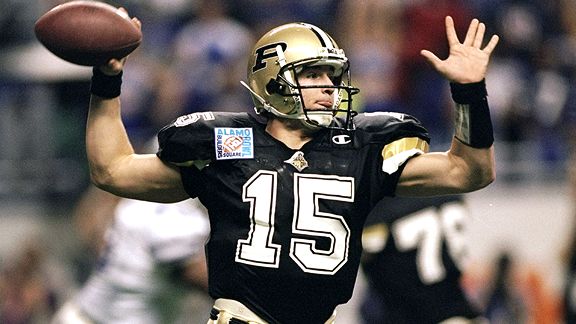
But there is definitely some kind of ego wrapped up in a decision like this, because it’s not like you see Adrian Gonzalez flying up to Portland to play for the Beavers and see some more pitches before he steps in against the Dodgers. Nor do you see Drew Brees fly back to Purdue to lead the Boilermakers on Saturdays before he straps on that Saints helmet on Sundays. Nowhere else in sports do you see a major-league level athlete purposely compete against minor-league opponents other than in NASCAR.
With most of these drivers, it’s probably a combination of wanting to have more success and just not knowing what else to do with their time. One thing I’ve learned about racecar drivers over the years is that when they’re not racing, they’re thinking about racing. And when they’re not thinking about racing, they’re dead. So these guys probably just like racing.
And I’m sure that’s part of it with Busch as well, but the spoiled, whiny kid I hear in the post-race interviews tells me that he just wants to be better than other people, even if he has to take on someone who is decidedly not his own size, metaphorically speaking.
Personally, I think NASCAR should consider some kind of rule to regulate which drivers are allowed to drive in which series, for the good of the sport. If you think about it, if the seven drivers I just mentioned who drive full-time in both the Sprint Cup and Nationwide series had to decide which series to race in, that would open up seven seats to younger drivers who could use the added experience before they made the jump to the Sprint Cup Series.
Here’s what I would suggest—allow a driver to run in no more than two series at a time, and after he has been run a full schedule in the Sprint Cup Series for three consecutive years, he is no longer eligible to race in any other series, unless he stops racing full time in the Sprint Cup Series. That way, once you get to the big leagues, you can’t take your talents down to the minor leagues and dominate.
Which brings up my final point—these guys should be dominating the Nationwide series (and especially the truck series)! Kyle Busch is an elite stock car driver in the prime of his career! The fact that he doesn’t win every truck race and every Nationwide race should be more of a point of personal shame than the elation brought about by winning every now and then against what are essentially kids still learning the sport and old guys out for a good ol’ time at the track.
Perhaps it’s a symptom of our generation—look at what LeBron James just did, for example. Instead of wanting to carry a team and prove he’s the best basketball player of his era, he decided he wanted to beat everyone else, so he teamed up with his talented buddies to tip the scales in his favor. A number of writers have pointed out that James is like that annoying guy who comes out to play a pickup game, makes sure he stacks the teams with the best guys there, then trash talks you the whole game. At some point, it became more fun to win as the beneficiary of a loaded team than it is impressive to work really hard and be the best at something because you earned it.
The other side of that coin is that there are still, thankfully, a lot of athletes out there who go for glory with everything they have. Athletes like Brees (who went to New Orleans, brought a team and a region back to life with his energy, enthusiasm and talent, and won the Super Bowl), or Albert Pujols (who led the St. Louis Cardinals to the World Series title back in 2006), or Sidney Crosby (who won the Stanley Cup with the Pittsburgh Penguins in 2009) show us that there is still hope for athletes who work hard, learn from failure, and ascend to the pinnacle of their sport.
Kyle Busch could learn a few things from these guys.
As always, if you have any thoughts on this topic, or any topic, be sure to write to us at sports@valleycenter.com and tell us all about it.

Saturday, July 12, 2008

Why Don't Americans Love Soccer?

When Fernando Torres out-hustled German defender Philip Lahm and flicked the ball over goal keeper Jens Lehmann, it would have been easy to mistake my Valley Center apartment for a villa in the heart of Spain.
I admitted it last week; I’ve become a soccer fan, thanks in large part to the thrilling action in the European Championships. The tournament featured fantastic goals, stellar goal keeping, upsets galore and heroes in abundance.
But after the thrill of watching Spain win their first international championship in 44 years (and the writing thrill of getting to use “Spain” as a plural noun for the last time in a while), a collective yawn seemed to issue from the general public here in the U.S.
Now, don’t get me wrong; there are soccer fans in this country. This is probably more true here in San Diego County than it is in a lot of other places.
But given the magnitude of the championship game, the Hollywood-script-like unfolding of the tournament itself, and even the charisma of stars like Torres, I can’t imagine a better opportunity for casual fans to become hooked on the sport than Euro 2008.
All of this got me thinking about why professional soccer is so popular internationally, but has never really caught on here in the States.
I think it all begins with how different American culture is from that of the rest of the world.
It’s no secret that we in America enjoy, on average, a fairly affluent lifestyle. That plays a part, I’m sure, especially when it comes to the choice between buying hundreds of dollars worth of hockey gear versus some shin guards and socks, but more of what I’m talking about is the traditions and pastimes of our people.
The United States of America, as an independent nation, are only 228 years old, which is still infancy compared with so many other nations, especially those in Europe. History here is tri-cornered hats and muskets; history in Europe is knights and castles, or even gladiators and chariots.
Part of the independence process, as any teenager will tell you, is finding a set of unique interests. Nobody listens to the music their parents listened to, unless you really enjoy not having any friends.
In the case of a nation asserting its independence, a lot of the traditions of the old regime are cast aside as the citizens seek to create a unique culture. It doesn’t happen overnight, but after a while, people stop drinking tea with crumpets and start downing half-caf lattes with their luxury almond croissants. We have to look cool in front of all the other recently liberated countries, after all.
It carries over into the sports world, as we shift from following the games of our forebears to watching the competitions we see as fresh and challenging. Why watch a bunch of sissies in shorts kick a ball around and flail on the ground at the slightest hint of contact when we could have muscle-bound behemoths strap on a set of pads and wallop each other in the mouth over and over again? For the record, I’m referencing the NFL, not American Gladiators. Although there really isn’t much difference anymore, is there?
Americans are notorious around the globe for being, stereotypically, loud, obnoxious, blood-thirsty buffoons, especially when it comes to sports. I hate to admit it, but look at the image differences between our NASCAR with their IndyCar series; as much as he’d like to try, I don’t think that Dale Earnhardt Jr. has quite the same sophistication of Helio Castroneves.
But in reality, we’re just trying to be innovative. Baseball started out as an updated, more challenging version of cricket. Basketball took the intricacies of soccer and added the challenge of using your hands to score a goal. Hockey took goal-based sports to another level, adding ice, skates, sticks and little slabs of vulcanized rubber, as well as giving a nice little boost to the orthodontic field. The NFL… Well, the NFL just figured that rugby needed a little less chaos. Or, at least, some time between plays to figure out how best to maim the other team’s star player.
And so as the new, challenging sports become more and more popular, the younger generations gravitate towards athletes that personify the attributes they themselves wish they had. No longer are skills like endurance, patience, grace and quick feet in such high demand; today’s American athletes are praised for toughness, improvisation, and the ability to silence the critics at every opportunity.
In short, we like athletes who stick it to the competition, even if we catch ourselves and say that winning isn’t everything and there’s no “I” in team. I admit it; I enjoyed watching Eli Manning beat the Patriots in the Super Bowl, even though the Giants had no business winning that game. The Patriots are old school, the old regime, and they got taken down by some hot shot quarterback with a chip on his shoulder. Who doesn’t love that?
One of the negative aspects of this sports independence is that the players seem to have a hard time generating national pride within their respective sports. Soccer players in Europe, and even in South America and other parts of the world, play for their club teams as a job. But when international competition comes around, the players seem to get a little more fire in their bellies. They realize that they’re not just playing for a coach, or for a logo; they’re playing for their country. Michael Ballack may play for Chelsea during the season, but European soccer fans know that he plays for Germany when the important trophies are on the line.
By contrast, it’s hard to find that level of national pride here. Look at the difficulties in selecting a U.S. Olympic men’s basketball team; it always seems like a series of minor injuries keep some of the big names from competing. A European soccer player would probably get attacked by a crazed hooligan if he missed the World Cup because of a strained calf, but if Tracy McGrady’s back is a little stiff, he’d rather not risk any further injury in the off-season.
Because of this national apathy, sports that have a more international appeal tend to go all but unnoticed here in the States. And because they don’t get as much coverage on ESPN (much less the endless debates on Sportscenter, Pardon The Interruption, Around The Horn, Mike & Mike In The Morning, or any of the other innumerable sports talk shows), fans don’t have the ready access to the ins and outs of the game.
For example, if a casual sports fan in America decides that he or she wants to follow the NFL more closely, there are a number of outlets available to learn the intricacies of the game. Want to know how to look off the safety to find the open receiver? Ron Jaworski breaks down offensive strategy every week on Sportscenter. Want to figure out the best blitz package to run against a west-coast offense? Tom Jackson will show you how it’s done on NFL Primetime. Want to find out how Michael Vick is doing in his prison football league? There’s a better-than-average chance that Trey Wingo will have that update on the next episode of NFL Live.
But if a casual fan wants to become a serious soccer fan, it’s a considerably more difficult proposition. I watched at least six international soccer games in the past two weeks, and I can barely explain what necessitates an offside call. I do know that soccer is actually called “football” in Europe, and that the field is actually called the “pitch,” but I don’t know what plays work best on a corner versus what plays work best on a free kick from outside the penalty area. I’m still not even sure why a play for the ball can be called a foul in one instance, then a seemingly identical play can be ignored by the referee. It seems kind of arbitrary.
That’s another thing that is likely keeping Americans from becoming die-hard soccer fans: the weird rules of the game.
For one thing, the clock doesn’t count down to zero from a pre-determined time; it starts at zero and the viewer is expected to know when it’s going to stop, if at all. Then, the clock doesn’t stop when the ball goes out of play, it just keeps going.
At the end of the half (which I managed to figure out is at the 45-minute mark), somebody (I’m still not sure who) decides how much “stoppage time” to add on. It’s usually between one and four minutes, although I don’t know if they’re keeping track or if they just ballpark it. When this stoppage time is over, the referee blows his whistle twice and the players walk off the field. Sometimes he blows the whistle with one minute gone, sometimes with 2:47, sometimes with 3:09. You never really know when it’s coming.
This happens again at the end of the game (the 90-minute mark), and possibly again at the end of both overtime periods (which are apparently 15 minutes each). The crowd doesn’t get to chant “five…four…three…two…one…” or anything like that. They just wait until the ref blows the whistle. It’s kind of anti-climatic.
It also brings up some controversy, as in the Euro 2008 quarterfinal game between Turkey and Croatia. The Croatians had scored late in the second extra period to take a one-goal lead, but Turkish forward Semih Senturk scored with just over a minute gone in stoppage time to tie the game. Croatia’s coach, Slaven Bilic, argued that the game should have been over, since the stoppage time was only to be one minute. According to the clock, one minute had expired before Senturk’s goal went in. But since the game ends on the referee’s whistle, and not on the expiration of time on the clock, the game went to penalty kicks and Turkey advanced to the semifinals.
Americans are generally not in favor of totalitarian rule, especially not in sports, so it’s easy to see how this could be a problem for the average fan. We like the rules to be objective and the outcome to be clear; we don’t like a guy in knee-high socks, shorts, and a shirt with a chest pocket to arbitrarily decide who wins and who goes home.
So given these things, will soccer ever have a true following here in the United States? I think it will.
At some point, the NFL will become the old standard and younger fans will have a hard time relating to it in the same way their parents did. It’s happening with baseball, and it most certainly can happen in football.
But until then, soccer will need to keep proving to American fans that it’s just as exciting and relevant as the “popular” sports that dominate the headlines.
And this year’s European Championship was a great start.
-- -- --
In the meantime, I’m going to miss the excitement of Euro 2008, and I’m looking to keep this soccer buzz going.
If you’re a soccer fan, drop me a line or two about why you love the sport, and I’ll put it in next week’s issue of The Roadrunner.
Write me at sports@valleycenter.com and tell me what makes soccer fun to play, fun to watch, or even just fun to talk about, and why you’re a fan.
And while you’re at it, see if you can explain that whole offside thing to me again.
I’m still not sure exactly how that works.