Showing posts with label ESPN. Show all posts

Friday, August 19, 2011

I Kid You Not--fantasty football draft strategy

Should you grab quarterback Michael Vick with your first pick? Depends on your strategy...

You’ve enjoyed your summer.
You’ve eaten your hot dogs at family picnics, you’ve gone to the beach, and you’ve even found the time to avoid doing anything resembling hard work.
But now that August is here again, it’s time to shift our collective minds back into gear to tackle the really important things once again.
And obviously, that begins with preparing for your fantasy football draft.
In years past, I’ve shared my thoughts about sleepers and snoozers—or if you prefer layman’s terms, guys you want and guys you don’t.
This year, in part because of the recently-resolved NFL lockout, and in even larger part because of the aforementioned summer plans of eating hot dogs and avoiding hard work, I’m not going to do that.
Instead, I’ve decided to help you tackle your overall draft strategy. In the end, it kind of doesn’t matter what players you have—so much of the game is luck, plus you can easily go to about 84 different places online to get “expert” advice, and part of what makes fantasy football fun is rooting for the guys you like, so go ahead and draft the guys you like—so instead of talking about specific players, let’s look at some options for how your team could look once the drafting is over.
It never hurts to have a plan, especially when you come to the sudden realization that you’re the only guy (or girl!) in your league who doesn’t have one, and you start re-thinking that decision to draft T.J. Houshmandzadeh last year (even though you just couldn’t resist quoting that ESPN commercial).
All slight variations aside, there are five directions you can take your fantasy football team on draft day, and it pretty much comes down to what you do with your first three or four picks. Let’s dive in and see what we can discover.

Quarterback
The strategy here is to grab a quarterback with your first pick, no matter who else is on the board. If you’re picking in the top five, you can land Michael Vick and simultaneously bookmark WebMD so you know exactly how serious every tweaked ankle really is. If you’re outside the top five, you can hope Aaron Rodgers didn’t just have the best season of his life last year, or that Drew Brees plays better than his haircut makes him look.
Pros: My favorite sportswriter, Bill Simmons, once said that having a crappy fantasy QB is like driving a four-cylinder car. Yeah, it works, but it just isn’t a whole lot of fun. And if you’re into having fun with your fantasy football team, then you should probably help the rest of us convince that one guy in every league who takes it way too seriously. You know—the guy who writes about fantasy football for the local newspaper every summer. Oh wait…
Plus, if you look at the statistics (always dangerous, I know), you can see that the difference between a great QB and a mediocre QB is bigger than the difference between the top players at other positions and their mediocre counterparts. If math is your thing, this might be something to pay attention to.
Cons: If your fun, six-cylinder QB tweaks an ankle, bruises a shoulder, gets his head slammed into the turf, or just flat-out stinks like a redneck barbecue, you’re stuck with a nightmare all season. A lot of pressure gets packed into that one pick.
Plus, you almost have to tag-team this strategy with the “make sure you get the best tight end available” strategy so you can maximize the whole point-differential thing. And unless you want to draft a tight end with your third pick, that might be difficult.

Running Back
A strategy as old as the game itself—running backs win fantasy football championships. The strategy is to grab a stud RB who can carry your team to the title.
Pros: Running backs get the ball consistently, which is what you want in fantasy sports. There’s nothing worse than suffering through a feast-or-famine-that’s-mostly-famine season with a streaky QB or WR threatening to obliterate your lineup every Sunday. Well, that redneck barbecue might be worse, but let’s just move on.
Cons: The days of Earl Campbell, Eric Dickerson, Emmitt Smith, Curtis Martin, Marshall Faulk, Priest Holmes, Jamal Lewis and LaDanian Tomlinson are well behind us, no matter what Tomlinson fans try to tell you this year. Coaches these days worry about running backs like they’re used cars—nobody wants to have to get a new one when the old one breaks down. So a stud running back gets maybe 80% of his team’s carries, while a decent running back gets maybe 70% of the action. Not to mention the trend of more passing in the game than ever before.

Wide Receivers
The NFL is a passing league! Run-heavy offenses died out with Curly Lambeau and the leather helmet! Airing it out not only wins games, it keeps the crowds coming back! Exclamation points are great for emphasizing a point!
This strategy involves going after wide receivers with your first two picks, then worrying about everything else. If you have a mid- to late-round pick, this could be intriguing.
Pros: You lock up studs at one position, hopefully avoiding injuries and essentially forgetting about those two slots in your lineup for the rest of the year. Not bad for those who like some degree of peace of mind.
Plus, there are always players who make surprise leaps to fantasy relevance every year, so when you lose your first three matchups, you have the waiver priority to snatch up this year’s steals.
Cons: The rest of your team is awful, and you find yourself asking questions like, “Who sees more third-down action for the Jacksonville Jaguars, Deji Karim or Greg Jones?” And that, I assure you, is not a place you want to be in December.

One Of Each
The thought here is to spread the wealth—grab a running back, then a quarterback, then a receiver, then a tight end, then running backs and receivers until the last two rounds.
Pros: It evens out your team a little bit and doesn’t leave big gaps. This is a nice strategy for people who like folding laundry and alphabetizing bookshelves in their spare time.
Cons: You can’t cover all the gaps, and if you follow a pattern too closely, you miss out on chances to snag a sleeper that other owners either forget about or don’t have room for.

Best Available
This is almost an actual NFL draft strategy, in that NFL owners throw around the “he was the best guy available” excuse when they don’t know what they’re doing and just grab the first name they find under the empty pizza boxes in the draft room.
Pros: You’re getting the best player available at any given moment. It never hurts to have good players.
Cons: You might end up with seven good wide receivers and a headache trying to figure out which ones to start each week. And when the later rounds start whizzing by, it gets harder and harder to know who the best player actually is, so there’s kind of a lot of guesswork that I don’t think any of us is qualified to do.
* * *
Hopefully this helps you make up your mind about how to strategize for your fantasy football draft this year.
Because if you don’t spend the time thinking about this stuff now, then you’ll probably end up actually getting something productive done, and we definitely can’t have that.
And be sure to share your thoughts with me by leaving a comment or sending me an e-mail to sports@valleycenter.com.

Friday, October 8, 2010

ESPN report: Dillon Baxter admits he's not working hard enough at USC

For those of you who watched the CIF Division IV football championship at the end of last season, you'll remember (painfully, if you're a Valley Center fan) that Mission Bay's Dillon Baxter ran roughshod through the muddied Jaguar defense for upwards of 400 yards.

At the time, I remember thinking that this kid was a prodigious talent, but I couldn't help but notice that his attitude seemed...a bit off.

For example, before the game started, both teams were out on the field warming up, each team on its own half. Baxter managed to situate himself right at the 50 yard line, closer to the Valley Center sideline than his own, and lo and behold, ended up in a bit of a jawing match with some of the Jaguars.

During the game, despite the fact that he was running around the field like a grown-up on the playground field with a bunch of kids, Baxter's teammates all but ignored their star on the sideline. Perhaps he purposely stood by himself, perhaps his teammates just didn't want to talk to him, perhaps it was a little of both. But it was in sharp contrast to Valley Center's recently-graduated phenom, James Johnson, who was always pumping up his teammates with encouragement, cheering on the team during the brief moments when he wasn't in the game, and talking with coaches about the game plan. Baxter seemed like he was already finished with Mission Bay (a theory supported by the USC beanie he was wearing after the game, which I noticed only after he was the absolute last player to go through the line to shake hands with the Jaguars).

He was pretty highly touted coming out of high school, and USC landed him. But this week, after a few disappointing efforts, this report came out on ESPN.com about Baxter's lack of effort.

He may be superbly talented, but as Johnson has shown at the University of Washington (earning a starting WR spot as a true freshman, but having been slowed by an ankle injury in his sophomore year) that hard work is what separates the great from the pretty good.

Thursday, August 19, 2010

I Kid You Not: Fantasy Football Sleepers & Snoozers 2010

You love football, I love football, and in less than a month, we’ll all be happy campers once again.
But for those of us who can’t get enough of the NFL with just the weekly games, there is fantasy football.
Although some may call it a fake sport, or just another way for nerds to crunch numbers, you can’t argue with the stats. Depending on where you get your stats, anywhere from 23 to 29 million Americans play fantasy football every year, and if you’re one of them, you know why.
The thrill of competition, the feeling of being involved with the players on your team, the simple joy of a T.J. Houshmandzadeh touchdown catch to help you beat Larry from accounting—it’s all just a part of the wonderful package.
If you’ve played fantasy football before, then you know how many opinions are out there masquerading as facts, telling you why a certain player is doomed to fail this season, or why you should avoid a certain player because it’s a surefire guarantee that he’s not going to make it through the season healthy.
If you’re new to fantasy football, it can seem a little overwhelming. But if you’re a veteran of the fantasy world, then you know how to take in all this raw data and form your own educated opinions, which are hopefully turned into beneficial decisions.
If you’re really good, you might start to express your own opinions to those around you. And since I’m one of those guys, I’m going to tell you who I think are some players with solid potential (sleepers) and who are guys I wouldn’t really want on my team (snoozers) for this season.
If you want hard data on these guys, there is no shortage of places to go to find what you’re looking for. The following is nothing more than one man’s opinion. Granted, one incredibly awesome, gifted, never-finished-worse-than-third-in-at-least-one-of-my-fantasy-leagues-since-I-started-playing kind of guy. But still—opinions they are.
With no further ado, let’s look at some players to snag and some players to avoid in fantasy football this year.

Sleepers

QB: Jason Campbell, Oakland Raiders
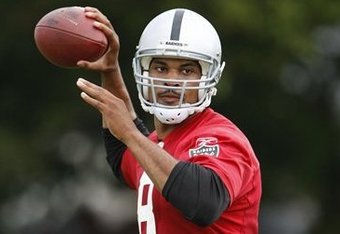
I know—the Raiders, you ask? Let’s just say that no team is going to look good when Jamarcus “That’s No Moon, That’s Our Quarterback” Russell...
...is overthrowing your receivers by 15 yards. Campbell is an accurate passer who brings confidence to an offense with some talent, but was mired in the cold, slippery grip of incompetence the past few seasons. They’re not going to win the Super Bowl, but Campbell will put up solid numbers all season.

Matthew Stafford, Detroit Lions
We saw some glimpses of Stafford’s ability and toughness last season, when he led the Lions to a last-minute victory over the Browns with an outstanding two-minute drive, shaking off a shoulder injury to re-enter on the final play and throw a touchdown pass that won the game. He’s still got his primary target, Calvin Johnson, as well as some new, potentially exciting talent on offense. I’m not saying he’s going to win the MVP, but if you still need a quarterback and he’s there in the late rounds, you could do a whole lot worse (see Jackson, Tarvaris).

RB: Ronnie Brown, Miami Dolphins
I’m a little biased here since I’m a Dolphins fan, but Brown has been a top-three fantasy running back at some point in each of the past four seasons. The reason he’s so commonly overlooked is because he was only able to finish one of the past four seasons, due to various injuries. Now, I can’t claim to know what will happen in the future. Well, I can claim that, but most of you would probably not believe me. Anyway, there’s a chance he could get hurt. But there’s a chance any player could get hurt, and Brown’s injuries were kind of fluky: a broken hand from a collision with an opponent’s helmet (2006), a torn ACL in his knee while making a tackle on an interception (2007), and a Lisfranc fracture in his right foot (2009). The ACL tear is a bit concerning, but he’s now gone two full seasons without any problems there, so why is there so much doubt that he will be healthy this year, any more than any other player? For fantasy purposes, you look at the potential cost/benefit analysis. Potential reward, you draft a top-ten fantasy running back (maybe better) with a fourth-round pick. Potential cost, he gets hurt and your fourth-round pick goes down the drain. To me, that’s not a huge risk. I mean, who else are you going to grab in that spot, Justin Forsett (who isn’t even the starter) or Jerome Harrison (of the Cleveland Browns… let me repeat that—THE CLEVELAND BROWNS)? Why not take a chance on a guy who has the talent and the opportunity to be an elite back?

Cadillac Williams, Tampa Bay Buccaneers
This one is for the late rounds, because I don’t really think anybody from the Tampa offense will be that great. But despite the seeming committee in the Buccaneer backfield, Caddy showed some promise at the end of last season after coming back from a torn patellar tendon the year before. He was outstanding in his rookie season (2005) and is just now finally coming all the way back from that injury. Instead of stocking up on kickers, I’d be willing to give Cadillac a test drive (note: I’m pretty sure this is the only time anyone has ever used that joke. Ever. Pretty sure.)

WR: Chris Chambers, Kansas City Chiefs
Look, there isn’t much to get excited about when you look at the Chiefs this year. Until last year, their quarterback made a living watching other (or rather, more talented) quarterbacks win football games—Matt Cassel was the backup to Carson Palmer and Matt Leinart at USC, then spent four seasons as Tom Brady’s designated baseball cap holder in New England. Their running backs either have some pretty good potential (Jamaal Charles and Dexter McCluster) or might be running out of gas (Thomas Jones). The offensive line isn’t great either, but word is that it might be getting better—emphasis on “might.”
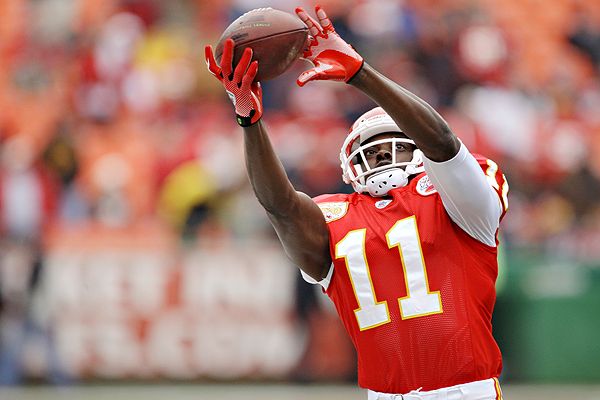
Their receivers aren’t much to look at either, but one thing we learned from the last half of 2009 was that Cassel somehow developed a rapport with Chambers, the number two wideout on the depth chart this year since Dwayne Bowe is pretty solidly established as the primary target.
Now I’m not saying that the Chiefs’ passing game is going to be electric, but I am saying that there seemed to be a connection between Cassel and Chambers last season, especially down the stretch—you know, when fantasy football match-ups are kind of important. If he’s still around in the later rounds, he’s probably going to be a good deal.

Josh Morgan, San Francisco 49ers
Pretty much, what I said about Chambers, apply that to Morgan. Also, Morgan is younger and his quarterback actually played in college.

Derrick Mason, Baltimore Ravens
Everybody’s all ga-ga for Anquan Boldin, and with good reason. But in my opinion, all his arrival does is open up more opportunities for Mason, who is as sure-handed as any number two receiver out there. The Ravens have a pretty exciting offense this year, and the way Ray Rice runs, you know there will be open spots for Mason in the secondary. Again, I don’t think he’s good enough to be your number one WR or anything, but if he’s there in the sixth or seventh round, I think you’ll do fine with him.

TE: Jermichael Finley, Green Bay Packers
Everybody thinks that Aaron Rodgers is going to have a monster year, and I agree. Finley is young, big, fast, and has great hands. He’s going to gobble up touchdown after touchdown this season.

Snoozers

QB: Donovan McNabb, Washington Redskins
McNabb is a tough place to start with the snoozers, because I don’t mean to imply that he’s going to be worthless. I just don’t think he’s going to put up the kinds of consistent fantasy numbers that he did last year with the Eagles. It’s a different system, he’s got new receivers to work with, and the ‘Skins actually run the ball from time to time. McNabb will end up with a decent season, I’d wager, but probably nothing significantly higher than Jason Campbell’s season totals for Washington last year. Basically, McNabb isn’t going to be as good as he was last year, so I would just be careful how high you rank him.

Carson Palmer, Cincinnati Bengals
Like Rodgers, a lot of people think Palmer will have a big year. He’s got the Ochocinco/Owens circus to ringlead, a (supposedly) talented rookie tight end, and a healthy Cedric Benson carrying the load. It looks really good on paper.
But they don’t play games on paper, probably because that would be a waste of paper, and it’s much easier to just play the game on your computer like the rest of us. Anyway, this is purely a gut thing, but I don’t think Palmer will be all that valuable come season’s end. He’ll have his days, I’m sure, but he plays some tough defenses (Pittsburgh and Baltimore twice each, New England, Atlanta, San Diego and the New York Jets among them) and he hasn’t really been all that great the past few seasons. I don’t think that another narcissist wide receiver in the locker room is going to help his demeanor much.

RB: C.J. Spiller, Buffalo Bills
He looks like he’s got lots of potential right now—good speed, an offense committed to the run, and the other two potential starting running backs (Fred Jackson and Marshawn Lynch) have picked up some minor injuries in the preseason.
But one of my new favorite words for this season—“meritocracy”—comes into play here. Jackson led the team in rushing last season, and Lynch is still a big, physical back who can pick up tough yards. Spiller may have talent, but in the NFL, the ball goes to the guys who earn it. Until Jackson and Lynch completely blow it out there, I feel like Spiller is doomed to a few chances here and there, at best.

Joseph Addai, Indianapolis Colts
He’s getting older, he plays on a team that doesn’t run very much, and he’s got a younger guy (Donald Brown) behind him who, according to the “insiders” who seem to know these things, is going to get more chances this year. Even if Addai gets the bulk of the Colts’ carries, he hasn’t really done much with them the past few years.

WR: Chad Ochocinco, Cincinnati Bengals
Read what I wrote about Carson Palmer again. Then add to it the fact that Ochocinco A) isn’t getting any younger (or faster), B) clearly doesn’t like sharing the spotlight, and C) gets easily frustrated when things aren’t going well. The Bengals play at New England to open the season, then host the Ravens in week two. I can’t imagine them winning either of those games, much less both. It could be a rough year in that locker room.

Miles Austin, Dallas Cowboys
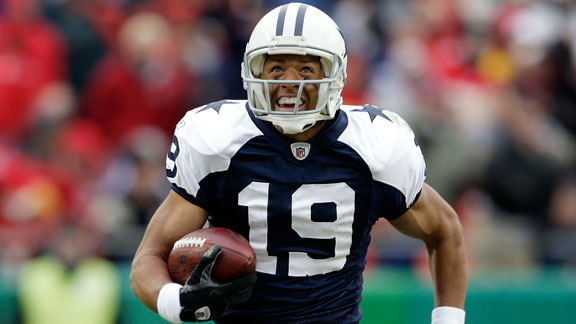
This one is similar to McNabb in that I’m not saying Austin will be terrible—I just think that all the hype has gotten a little out of hand. The Cowboys played well and Austin got a lot of points last year, but defenses kind of know he’s coming this year. Chances are he’ll get taken really early, and chances are, the guy (or girl) who drafted him in your league will end up just a little disappointed.

Any Receivers From The Pittsburgh Steelers
(like Mike Wallace...)
(oops, wrong Mike Wallace...um...here we go...)
Ben Roethlisberger is out for six weeks, and Byron Leftwich is no longer the same dude that got carried by his offensive linemen to run the two-minute drill at Marshall. Super Bowl MVP Santonio Holmes is gone, Hines Ward is still good but getting old, and I’m not entirely convinced that Mike Wallace (no, not the guy from 60 Minutes) can be considered elite. It’s not like they’ll be terrible, but for where they’re going in mock drafts right now, there are better guys out there.

TE: Greg Olsen, Chicago Bears
His quarterback likes throwing it to the other team, he’s got a much older guy pushing him for the starting spot (Desmond Clark), and his new offensive coordinator doesn’t really do much to get the tight end involved anyway. Yeah, you remember the Rams from the late 1990s, with Mike Martz as the offensive coordinator? The guy who helped make Kurt Warner, Isaac Bruce, Torry Holt and Marshall Faulk into superstars? Can you name the tight end from the 1999 Rams? It was this guy. In 16 games, he had all of 25 receptions. Not exactly lighting up the fantasy scoreboard.
— — —
There you have it, the official I Kid You Not sleepers and snoozers. Take this advice, go forth, and dominate your league.
Or wonder whether or not I gave you a bunch of false leads just to throw off any of the other owners in my league who might be reading this column. Maybe I’m giving good advice, or maybe I’m watching out for my own interests. I will let you decide.

Saturday, July 12, 2008

Why Don't Americans Love Soccer?

When Fernando Torres out-hustled German defender Philip Lahm and flicked the ball over goal keeper Jens Lehmann, it would have been easy to mistake my Valley Center apartment for a villa in the heart of Spain.
I admitted it last week; I’ve become a soccer fan, thanks in large part to the thrilling action in the European Championships. The tournament featured fantastic goals, stellar goal keeping, upsets galore and heroes in abundance.
But after the thrill of watching Spain win their first international championship in 44 years (and the writing thrill of getting to use “Spain” as a plural noun for the last time in a while), a collective yawn seemed to issue from the general public here in the U.S.
Now, don’t get me wrong; there are soccer fans in this country. This is probably more true here in San Diego County than it is in a lot of other places.
But given the magnitude of the championship game, the Hollywood-script-like unfolding of the tournament itself, and even the charisma of stars like Torres, I can’t imagine a better opportunity for casual fans to become hooked on the sport than Euro 2008.
All of this got me thinking about why professional soccer is so popular internationally, but has never really caught on here in the States.
I think it all begins with how different American culture is from that of the rest of the world.
It’s no secret that we in America enjoy, on average, a fairly affluent lifestyle. That plays a part, I’m sure, especially when it comes to the choice between buying hundreds of dollars worth of hockey gear versus some shin guards and socks, but more of what I’m talking about is the traditions and pastimes of our people.
The United States of America, as an independent nation, are only 228 years old, which is still infancy compared with so many other nations, especially those in Europe. History here is tri-cornered hats and muskets; history in Europe is knights and castles, or even gladiators and chariots.
Part of the independence process, as any teenager will tell you, is finding a set of unique interests. Nobody listens to the music their parents listened to, unless you really enjoy not having any friends.
In the case of a nation asserting its independence, a lot of the traditions of the old regime are cast aside as the citizens seek to create a unique culture. It doesn’t happen overnight, but after a while, people stop drinking tea with crumpets and start downing half-caf lattes with their luxury almond croissants. We have to look cool in front of all the other recently liberated countries, after all.
It carries over into the sports world, as we shift from following the games of our forebears to watching the competitions we see as fresh and challenging. Why watch a bunch of sissies in shorts kick a ball around and flail on the ground at the slightest hint of contact when we could have muscle-bound behemoths strap on a set of pads and wallop each other in the mouth over and over again? For the record, I’m referencing the NFL, not American Gladiators. Although there really isn’t much difference anymore, is there?
Americans are notorious around the globe for being, stereotypically, loud, obnoxious, blood-thirsty buffoons, especially when it comes to sports. I hate to admit it, but look at the image differences between our NASCAR with their IndyCar series; as much as he’d like to try, I don’t think that Dale Earnhardt Jr. has quite the same sophistication of Helio Castroneves.
But in reality, we’re just trying to be innovative. Baseball started out as an updated, more challenging version of cricket. Basketball took the intricacies of soccer and added the challenge of using your hands to score a goal. Hockey took goal-based sports to another level, adding ice, skates, sticks and little slabs of vulcanized rubber, as well as giving a nice little boost to the orthodontic field. The NFL… Well, the NFL just figured that rugby needed a little less chaos. Or, at least, some time between plays to figure out how best to maim the other team’s star player.
And so as the new, challenging sports become more and more popular, the younger generations gravitate towards athletes that personify the attributes they themselves wish they had. No longer are skills like endurance, patience, grace and quick feet in such high demand; today’s American athletes are praised for toughness, improvisation, and the ability to silence the critics at every opportunity.
In short, we like athletes who stick it to the competition, even if we catch ourselves and say that winning isn’t everything and there’s no “I” in team. I admit it; I enjoyed watching Eli Manning beat the Patriots in the Super Bowl, even though the Giants had no business winning that game. The Patriots are old school, the old regime, and they got taken down by some hot shot quarterback with a chip on his shoulder. Who doesn’t love that?
One of the negative aspects of this sports independence is that the players seem to have a hard time generating national pride within their respective sports. Soccer players in Europe, and even in South America and other parts of the world, play for their club teams as a job. But when international competition comes around, the players seem to get a little more fire in their bellies. They realize that they’re not just playing for a coach, or for a logo; they’re playing for their country. Michael Ballack may play for Chelsea during the season, but European soccer fans know that he plays for Germany when the important trophies are on the line.
By contrast, it’s hard to find that level of national pride here. Look at the difficulties in selecting a U.S. Olympic men’s basketball team; it always seems like a series of minor injuries keep some of the big names from competing. A European soccer player would probably get attacked by a crazed hooligan if he missed the World Cup because of a strained calf, but if Tracy McGrady’s back is a little stiff, he’d rather not risk any further injury in the off-season.
Because of this national apathy, sports that have a more international appeal tend to go all but unnoticed here in the States. And because they don’t get as much coverage on ESPN (much less the endless debates on Sportscenter, Pardon The Interruption, Around The Horn, Mike & Mike In The Morning, or any of the other innumerable sports talk shows), fans don’t have the ready access to the ins and outs of the game.
For example, if a casual sports fan in America decides that he or she wants to follow the NFL more closely, there are a number of outlets available to learn the intricacies of the game. Want to know how to look off the safety to find the open receiver? Ron Jaworski breaks down offensive strategy every week on Sportscenter. Want to figure out the best blitz package to run against a west-coast offense? Tom Jackson will show you how it’s done on NFL Primetime. Want to find out how Michael Vick is doing in his prison football league? There’s a better-than-average chance that Trey Wingo will have that update on the next episode of NFL Live.
But if a casual fan wants to become a serious soccer fan, it’s a considerably more difficult proposition. I watched at least six international soccer games in the past two weeks, and I can barely explain what necessitates an offside call. I do know that soccer is actually called “football” in Europe, and that the field is actually called the “pitch,” but I don’t know what plays work best on a corner versus what plays work best on a free kick from outside the penalty area. I’m still not even sure why a play for the ball can be called a foul in one instance, then a seemingly identical play can be ignored by the referee. It seems kind of arbitrary.
That’s another thing that is likely keeping Americans from becoming die-hard soccer fans: the weird rules of the game.
For one thing, the clock doesn’t count down to zero from a pre-determined time; it starts at zero and the viewer is expected to know when it’s going to stop, if at all. Then, the clock doesn’t stop when the ball goes out of play, it just keeps going.
At the end of the half (which I managed to figure out is at the 45-minute mark), somebody (I’m still not sure who) decides how much “stoppage time” to add on. It’s usually between one and four minutes, although I don’t know if they’re keeping track or if they just ballpark it. When this stoppage time is over, the referee blows his whistle twice and the players walk off the field. Sometimes he blows the whistle with one minute gone, sometimes with 2:47, sometimes with 3:09. You never really know when it’s coming.
This happens again at the end of the game (the 90-minute mark), and possibly again at the end of both overtime periods (which are apparently 15 minutes each). The crowd doesn’t get to chant “five…four…three…two…one…” or anything like that. They just wait until the ref blows the whistle. It’s kind of anti-climatic.
It also brings up some controversy, as in the Euro 2008 quarterfinal game between Turkey and Croatia. The Croatians had scored late in the second extra period to take a one-goal lead, but Turkish forward Semih Senturk scored with just over a minute gone in stoppage time to tie the game. Croatia’s coach, Slaven Bilic, argued that the game should have been over, since the stoppage time was only to be one minute. According to the clock, one minute had expired before Senturk’s goal went in. But since the game ends on the referee’s whistle, and not on the expiration of time on the clock, the game went to penalty kicks and Turkey advanced to the semifinals.
Americans are generally not in favor of totalitarian rule, especially not in sports, so it’s easy to see how this could be a problem for the average fan. We like the rules to be objective and the outcome to be clear; we don’t like a guy in knee-high socks, shorts, and a shirt with a chest pocket to arbitrarily decide who wins and who goes home.
So given these things, will soccer ever have a true following here in the United States? I think it will.
At some point, the NFL will become the old standard and younger fans will have a hard time relating to it in the same way their parents did. It’s happening with baseball, and it most certainly can happen in football.
But until then, soccer will need to keep proving to American fans that it’s just as exciting and relevant as the “popular” sports that dominate the headlines.
And this year’s European Championship was a great start.
-- -- --
In the meantime, I’m going to miss the excitement of Euro 2008, and I’m looking to keep this soccer buzz going.
If you’re a soccer fan, drop me a line or two about why you love the sport, and I’ll put it in next week’s issue of The Roadrunner.
Write me at sports@valleycenter.com and tell me what makes soccer fun to play, fun to watch, or even just fun to talk about, and why you’re a fan.
And while you’re at it, see if you can explain that whole offside thing to me again.
I’m still not sure exactly how that works.