Date----------VS-----------Location-------------Time (JV/V)
8/27------(Scrimmage)------Mira Mesa------------3:00/4:30
9/3-------San Pasqual------Valley Center----------4:30/7:00
9/10------La Quinta--------Valley Center----------4:30/7:00
9/17------La Jolla----------Valley Center----------4:30/7:00
9/24------Los Alamitos-----Valley Center----------4:30/7:00
10/1------Ramona----------Ramona-------------4:30/7:00
10/8------Escondido--------Escondido-----------4:30/7:00
10/15-----San Marcos------VC (homecoming)------4:30/7:00
10/22-----Mt. Carmel-------Mt. Carmel-----------4:30/7:00
11/5------Del Norte--------Del Norte------------4:30/7:00
11/12-----Orange Glen-----Valley Center----------4:30/7:00
Tuesday, August 10, 2010

Jaguars Want More Than CIF Runner-Up In Football This Year
It might be easy to hang your proverbial hat on the success of a season in which your team made it to the CIF championship game, amassing an 11–2 record along the way, and setting a new school record for most wins in the regular season.
But Valley Center head football coach Rob Gilster knows that the easy way isn’t always the best way.
The Jaguars head into the 2010 season with the slogan, “We want more,” and coach Gilster says it’s an attitude that has defined the team so far this off-season.
“This is a team that wants to keep achieving and hopes to go further than we did last year,” he says. “Obviously, being the CIF champs is the pinnacle of what we’re chasing after, and our ultimate goal is to strive to be the best. We know that being the best means that you get a win in that last game of the year.”
Part of the challenge of improving on last season’s title-game run will be finding a way to replace a player who accounted for more than 2,200 yards of offense a year ago. The hole left by graduated running back Stanton Upson will be filled this year by Travis Bernard, who was used mainly as a slot receiver last season.
“Travis will be our first option, but we have a few guys who can run the ball, including Kenny Thomas, Mike Rodriguez and Garrett Fiehler,” coach Gilster says. “But Travis is ready to take on that role. He’s always wanted to be a running back, but when he got to the varsity level, Stanton was already established there, so we had to find ways to get Travis involved on offense. He’s had to wait his turn to be the go-to guy, but he’s always had the ability.”
Quarterback Beau Reilly returns to lead the offense in his senior season, and coach Gilster is excited about the development of the young passer.
“He’s improved a lot this off-season,” he says. “He’s gotten bigger and a lot stronger, and the experience he gained from last year is invaluable.”
Up front, the offensive line has some returning starters, but overall, coach Gilster has a young group of blockers to work with.
“Overall, we’re real young on the line, but I’m excited to work with these guys,” he says. “We’ll have some guys moving up from JV, but we’ll have a couple guys with some starting experience back this year, including [center] Andy Fletcher.”
Former tackle Stehly Reden will move to tight end this season, a position he played on occasion last year. Joining him is incoming transfer Jean-Marc Briere, and with returning receivers Taylor Oshinski and Tommy Aguilar, along with John Watkins moving up from JV, the receiving corps makes up a position that coach Gilster sees as a strength this season.
“We always strive to be a balanced team, so if we’re right around the sixty-forty mark for running and passing, whichever way it goes, then we’re right around where we want to be,” he says. “But we never want to be predictable, and with the weapons we have on offense, I think we’re going to be able to keep defenses on their heels.”
On the other side of the ball, the graduation of middle linebacker Patrick Preston leaves a big gap to fill, but with Jacob Beason returning from an injury, along with Martin Cunningham moving back to middle linebacker from nose tackle, coach Gilster says the defense has some solid players up front.
“These guys are disciplined, excited to play, and they’re tough guys,” he says.
The defensive secondary looks solid as well, with returning starters Aguilar and David Last at cornerback, along with Bernard coming back to play safety.
But even with a hard-working, experienced team looking to make another run for a CIF championship, coach Gilster knows that the Jaguars will need to play at an elite level throughout the season, especially with some challenging new opponents added to the talented teams already on the schedule.
“It’s going to be a tough schedule this year,” he admits. “San Pasqual, Ramona and Mount Carmel are always good teams, and we play at Escondido this year, which is always a tough place to play. We also have La Quinta and Los Alamitos, which is a big school up in Orange County, so we know we’re going to have to prepare if we’re going to be successful.”
The Jaguars kick off the 2010 season with a scrimmage at Mira Mesa on Aug. 27 before the regular-season opener takes place against San Pasqual at Valley Center at 7 p.m. on Sept. 3.
But Valley Center head football coach Rob Gilster knows that the easy way isn’t always the best way.
The Jaguars head into the 2010 season with the slogan, “We want more,” and coach Gilster says it’s an attitude that has defined the team so far this off-season.
“This is a team that wants to keep achieving and hopes to go further than we did last year,” he says. “Obviously, being the CIF champs is the pinnacle of what we’re chasing after, and our ultimate goal is to strive to be the best. We know that being the best means that you get a win in that last game of the year.”
Part of the challenge of improving on last season’s title-game run will be finding a way to replace a player who accounted for more than 2,200 yards of offense a year ago. The hole left by graduated running back Stanton Upson will be filled this year by Travis Bernard, who was used mainly as a slot receiver last season.
“Travis will be our first option, but we have a few guys who can run the ball, including Kenny Thomas, Mike Rodriguez and Garrett Fiehler,” coach Gilster says. “But Travis is ready to take on that role. He’s always wanted to be a running back, but when he got to the varsity level, Stanton was already established there, so we had to find ways to get Travis involved on offense. He’s had to wait his turn to be the go-to guy, but he’s always had the ability.”
Quarterback Beau Reilly returns to lead the offense in his senior season, and coach Gilster is excited about the development of the young passer.
“He’s improved a lot this off-season,” he says. “He’s gotten bigger and a lot stronger, and the experience he gained from last year is invaluable.”
Up front, the offensive line has some returning starters, but overall, coach Gilster has a young group of blockers to work with.
“Overall, we’re real young on the line, but I’m excited to work with these guys,” he says. “We’ll have some guys moving up from JV, but we’ll have a couple guys with some starting experience back this year, including [center] Andy Fletcher.”
Former tackle Stehly Reden will move to tight end this season, a position he played on occasion last year. Joining him is incoming transfer Jean-Marc Briere, and with returning receivers Taylor Oshinski and Tommy Aguilar, along with John Watkins moving up from JV, the receiving corps makes up a position that coach Gilster sees as a strength this season.
“We always strive to be a balanced team, so if we’re right around the sixty-forty mark for running and passing, whichever way it goes, then we’re right around where we want to be,” he says. “But we never want to be predictable, and with the weapons we have on offense, I think we’re going to be able to keep defenses on their heels.”
On the other side of the ball, the graduation of middle linebacker Patrick Preston leaves a big gap to fill, but with Jacob Beason returning from an injury, along with Martin Cunningham moving back to middle linebacker from nose tackle, coach Gilster says the defense has some solid players up front.
“These guys are disciplined, excited to play, and they’re tough guys,” he says.
The defensive secondary looks solid as well, with returning starters Aguilar and David Last at cornerback, along with Bernard coming back to play safety.
But even with a hard-working, experienced team looking to make another run for a CIF championship, coach Gilster knows that the Jaguars will need to play at an elite level throughout the season, especially with some challenging new opponents added to the talented teams already on the schedule.
“It’s going to be a tough schedule this year,” he admits. “San Pasqual, Ramona and Mount Carmel are always good teams, and we play at Escondido this year, which is always a tough place to play. We also have La Quinta and Los Alamitos, which is a big school up in Orange County, so we know we’re going to have to prepare if we’re going to be successful.”
The Jaguars kick off the 2010 season with a scrimmage at Mira Mesa on Aug. 27 before the regular-season opener takes place against San Pasqual at Valley Center at 7 p.m. on Sept. 3.
I Kid You Not: Football Is King
I looked my wife in the eye one day this week and confessed to her that I have a problem.
“It’s only August,” I explained. “And I already can’t wait for football to start.”
As she sympathetically (sarcastically?) assured me that this month will fly right by, I reflected on the fact that there are very few things that can get my insides all squirrelly a full month in advance. Granted, I love Thanksgiving and Christmas as much as the next guy, but once you get past the age of 12, there really isn’t much to get excited about. Except being able to stuff your face, but you can really do that any other day of the year. I mean, this is America, after all.
In the realm of sports, there really isn’t anything that I get this excited about. I grew up playing baseball, and I still get to relive my glory days (those being my MVP season for the City Rec League Astros in the summer of 1993, complete with the accompanying soundtrack of You’re The Best Around by Joe Esposito) on the slow-pitch softball field. I loved watching the World Cup this summer, I really enjoy hockey season (when I can actually find a game on TV, which is rare), and going to see the Padres play is always a good time (especially this year, when they’re actually going to win the division even though they’re going to fold like every other year).
But none of these things really get me pumped up the way that football season does. And I’m not just talking about the NFL, either, although that is the main source of my anticipatory glee. I talked with Valley Center varsity football coach Rob Gilster this week about the Jaguars’ upcoming season, and I have to say, I’m really looking forward to Friday nights this fall. (Be sure to check out the 2010 VCHS football preview to your left).
So I started wondering, what about football season sets it apart from all these other things I enjoy? And why do so many people seem to feel the same way?
I think there are three things about football that make September one of the most anticipated months of the year. And since I like you so much, I’m going to share these three things with you right now. You’re welcome.
1. The Ideal Format
The most basic level of enjoyment in the world of sports comes from simply being able to watch a game. Whether you like the teams or not, whether you fully understand the strategy or not, or if you just want to spend an enjoyable evening with friends, sports are a lot of fun. So the more games there are, the better, right?
Wrong. The Padres play 180 games every year, and last season, they averaged under 24,000 fans in attendance per game. That’s slightly over half the capacity of Petco Park. Ouch. And that’s not saying anything against the Padres, it just proves the point that a Thursday night game in April against the Milwaukee Brewers (attendance: 16,696 for the game on April 29 of this year, by the way) just can’t help but be met with a bit of a collective yawn. Honestly, once anything starts to reach a level of oversaturation, it loses some of its appeal.
In contrast, the Chargers haven’t had a regular-season game blacked out (NFL rules stipulate that a game won’t be shown on local television if the team hasn’t sold all the tickets for that game) since 2004, and there are plenty of news articles written about how the Chargers aren’t exactly the best in the league when it comes to selling out games. And even though NFL tickets are exponentially more expensive than MLB tickets, the Chargers sell out their home games because fans know there are only eight of them every season (plus a few playoff games, if they get there). When something cool only happens eight times a year, it’s a lot more likely that you’ll plunk down the $50+ just to go see it. Even if the team is lame, it’s still better than snoozing through another Jon Garland-vs.-Adam Wainwright one-run shoot-out (from May 25 of this year, attendance: 18,236).
Which brings up another point—football is just more fun to watch. The play happens, there’s a little break for some replays, then another play happens. It’s not stare-off-into-space-while-contemplating-the-cosmos boring like baseball can be, but it’s not continuous action like hockey and soccer. You get to see stuff happening, but you also get little pauses to allow the analysts to help you understand what just happened. As far as fan-friendly sports go, football has the ideal setup.
That format even extends to the way the season plays out. Because each team only plays one game each week, fans only have to block out one day a week to watch their favorite team. If you really want to devoutly follow the Toronto Maple Leafs or the Cleveland Cavaliers (although I can’t imagine why) or the Texas Rangers, you pretty much can’t have a life during the season. Not that anyone who is a diehard Cavs fan can claim to have much of a life anyway, but at least a committed football fan has the luxury of six days a week to do other things. Granted, most of us football fans use those six days to dissect every play that happened on Sunday (or Monday night), but still, it’s nice to know we could have a life.
2. The Popularity
I’ve admitted before that the way my sports fanship has come about is because of my sports hatred. Basically, the teams I like are the rivals of the teams I don’t like. I like the Miami Dolphins because I grew up in Western New York and was sick of all the Buffalo Bills fans. I like the Mets and the Red Sox in large part because I can’t stand the Yankees.
A lot of the reason why I don’t like certain teams is because they’re overly popular. I still can’t talk about Jim Kelly, Thurman Thomas or Andre Reed without getting a look of snarling anger on my face, because when I was growing up, all the Buffalo-area news stations would just gush about the K-Gun offense and Marv Levy and Cornelius “The Biscuit” Bennett and the amazing (read: cheating) comeback against the Houston Oilers in January of 1993 and all the rest.
So why would I advocate the benefits of enjoying something that’s popular?
I’m glad you asked. Really, it comes down to accessibility and the potential for enjoyment that comes from being able to get into something easily.
And football is easy to find. If you want to know who will be the starting running back for the Seattle Seahawks this season, there are plenty of experts whose job is to watch the Seattle Seahawks and tell the world which tailback figures to get the most touches this season. If you want to find out how to spot an outside linebacker blitz, I know of at least four different shows on television that feature experts explaining these “X’s and O’s” kind of details. If you want to know which NFL player Kim Kardashian is currently exploiting dating, it doesn’t take more than a couple clicks of the mouse.
In short, it’s not hard to go from casual fan to diehard with very little personal effort. My wife is a good example—back before we got married, I started inviting her over to watch football with me on Sundays, and before the end of the season, she knew more about some teams than I did. OK that’s probably a bit of an exaggeration, but not really by a lot. She knows her stuff, and she’s looking forward to the season almost as much as I am.
3. Fantasy Football
The final threshold for the transition from casual fan to diehard, fantasy football is almost a sport in and of itself. It falls into the previous two categories we’ve discussed (it only happens once a week and it’s popular) which makes it an ideal way for football fans to add another layer of enjoyment to the game.
I’ve played fantasy football for the past seven years now, and I have to say, I’m probably more excited about my various FFL (Fantasy Football League) drafts than I am about the NFL’s opening weekend.
If you still don’t know what fantasy football is (apparently those people still exist), it’s basically a league of people who take turns picking the various NFL players to form their own teams. Each player earns a certain number of points based on how he performed in his NFL game that week (as in, if Tony Romo throws a touchdown pass, he gets six points for his FFL “owners”) and the teams in each FFL compete against each other using these point totals to determine a winner each week. There are different formats and different scoring rules depending on the league, but the basics are the same.
What fantasy football does is give football fans an excuse to be interested in players and teams that they may not pay much attention to otherwise. Last season, I had Washington Redskins receiver Santana Moss in one of my leagues. Would I pay much attention to the Redskins if I didn’t have Moss? Probably not. But because I counted on him as my number two receiver, I had to find out if he was getting the ball as often as he should, and if he was getting chances to score touchdowns, and if he had any injury concerns. I learned more about a player, his team, and other players at his position because I was invested in my fantasy league.
And before you wonder just how big of a nerd I am, I have to say that all the investigation I did took very little time. Fantasy football is pretty universally free these days, and especially if you go with a site like ESPN.com, you get outstanding updates, live scoring and all the latest tools right at your fingertips. We literally had a seven-year-old owner in one of my leagues last year, and he did pretty well. He made it to the playoffs, if I remember correctly, and that’s not exactly a given.
I’m planning on writing a more robust fantasy football column in the next few weeks, complete with a few of my sleepers and snoozers, so if you’re at all interested in fantasy football, check back with us each week and be sure to write in to sports@valleycenter.com to share your thoughts on the subject.
In the meantime, I’m going to go curl up with a recording of Tom Jackson breaking down the zone blocking scheme in minute detail.
And I’m going to count the minutes until September.
“It’s only August,” I explained. “And I already can’t wait for football to start.”
As she sympathetically (sarcastically?) assured me that this month will fly right by, I reflected on the fact that there are very few things that can get my insides all squirrelly a full month in advance. Granted, I love Thanksgiving and Christmas as much as the next guy, but once you get past the age of 12, there really isn’t much to get excited about. Except being able to stuff your face, but you can really do that any other day of the year. I mean, this is America, after all.
In the realm of sports, there really isn’t anything that I get this excited about. I grew up playing baseball, and I still get to relive my glory days (those being my MVP season for the City Rec League Astros in the summer of 1993, complete with the accompanying soundtrack of You’re The Best Around by Joe Esposito) on the slow-pitch softball field. I loved watching the World Cup this summer, I really enjoy hockey season (when I can actually find a game on TV, which is rare), and going to see the Padres play is always a good time (especially this year, when they’re actually going to win the division even though they’re going to fold like every other year).
But none of these things really get me pumped up the way that football season does. And I’m not just talking about the NFL, either, although that is the main source of my anticipatory glee. I talked with Valley Center varsity football coach Rob Gilster this week about the Jaguars’ upcoming season, and I have to say, I’m really looking forward to Friday nights this fall. (Be sure to check out the 2010 VCHS football preview to your left).
So I started wondering, what about football season sets it apart from all these other things I enjoy? And why do so many people seem to feel the same way?
I think there are three things about football that make September one of the most anticipated months of the year. And since I like you so much, I’m going to share these three things with you right now. You’re welcome.
1. The Ideal Format
The most basic level of enjoyment in the world of sports comes from simply being able to watch a game. Whether you like the teams or not, whether you fully understand the strategy or not, or if you just want to spend an enjoyable evening with friends, sports are a lot of fun. So the more games there are, the better, right?
Wrong. The Padres play 180 games every year, and last season, they averaged under 24,000 fans in attendance per game. That’s slightly over half the capacity of Petco Park. Ouch. And that’s not saying anything against the Padres, it just proves the point that a Thursday night game in April against the Milwaukee Brewers (attendance: 16,696 for the game on April 29 of this year, by the way) just can’t help but be met with a bit of a collective yawn. Honestly, once anything starts to reach a level of oversaturation, it loses some of its appeal.
In contrast, the Chargers haven’t had a regular-season game blacked out (NFL rules stipulate that a game won’t be shown on local television if the team hasn’t sold all the tickets for that game) since 2004, and there are plenty of news articles written about how the Chargers aren’t exactly the best in the league when it comes to selling out games. And even though NFL tickets are exponentially more expensive than MLB tickets, the Chargers sell out their home games because fans know there are only eight of them every season (plus a few playoff games, if they get there). When something cool only happens eight times a year, it’s a lot more likely that you’ll plunk down the $50+ just to go see it. Even if the team is lame, it’s still better than snoozing through another Jon Garland-vs.-Adam Wainwright one-run shoot-out (from May 25 of this year, attendance: 18,236).
Which brings up another point—football is just more fun to watch. The play happens, there’s a little break for some replays, then another play happens. It’s not stare-off-into-space-while-contemplating-the-cosmos boring like baseball can be, but it’s not continuous action like hockey and soccer. You get to see stuff happening, but you also get little pauses to allow the analysts to help you understand what just happened. As far as fan-friendly sports go, football has the ideal setup.
That format even extends to the way the season plays out. Because each team only plays one game each week, fans only have to block out one day a week to watch their favorite team. If you really want to devoutly follow the Toronto Maple Leafs or the Cleveland Cavaliers (although I can’t imagine why) or the Texas Rangers, you pretty much can’t have a life during the season. Not that anyone who is a diehard Cavs fan can claim to have much of a life anyway, but at least a committed football fan has the luxury of six days a week to do other things. Granted, most of us football fans use those six days to dissect every play that happened on Sunday (or Monday night), but still, it’s nice to know we could have a life.
2. The Popularity
I’ve admitted before that the way my sports fanship has come about is because of my sports hatred. Basically, the teams I like are the rivals of the teams I don’t like. I like the Miami Dolphins because I grew up in Western New York and was sick of all the Buffalo Bills fans. I like the Mets and the Red Sox in large part because I can’t stand the Yankees.
A lot of the reason why I don’t like certain teams is because they’re overly popular. I still can’t talk about Jim Kelly, Thurman Thomas or Andre Reed without getting a look of snarling anger on my face, because when I was growing up, all the Buffalo-area news stations would just gush about the K-Gun offense and Marv Levy and Cornelius “The Biscuit” Bennett and the amazing (read: cheating) comeback against the Houston Oilers in January of 1993 and all the rest.
So why would I advocate the benefits of enjoying something that’s popular?
I’m glad you asked. Really, it comes down to accessibility and the potential for enjoyment that comes from being able to get into something easily.
And football is easy to find. If you want to know who will be the starting running back for the Seattle Seahawks this season, there are plenty of experts whose job is to watch the Seattle Seahawks and tell the world which tailback figures to get the most touches this season. If you want to find out how to spot an outside linebacker blitz, I know of at least four different shows on television that feature experts explaining these “X’s and O’s” kind of details. If you want to know which NFL player Kim Kardashian is currently exploiting dating, it doesn’t take more than a couple clicks of the mouse.
In short, it’s not hard to go from casual fan to diehard with very little personal effort. My wife is a good example—back before we got married, I started inviting her over to watch football with me on Sundays, and before the end of the season, she knew more about some teams than I did. OK that’s probably a bit of an exaggeration, but not really by a lot. She knows her stuff, and she’s looking forward to the season almost as much as I am.
3. Fantasy Football
The final threshold for the transition from casual fan to diehard, fantasy football is almost a sport in and of itself. It falls into the previous two categories we’ve discussed (it only happens once a week and it’s popular) which makes it an ideal way for football fans to add another layer of enjoyment to the game.
I’ve played fantasy football for the past seven years now, and I have to say, I’m probably more excited about my various FFL (Fantasy Football League) drafts than I am about the NFL’s opening weekend.
If you still don’t know what fantasy football is (apparently those people still exist), it’s basically a league of people who take turns picking the various NFL players to form their own teams. Each player earns a certain number of points based on how he performed in his NFL game that week (as in, if Tony Romo throws a touchdown pass, he gets six points for his FFL “owners”) and the teams in each FFL compete against each other using these point totals to determine a winner each week. There are different formats and different scoring rules depending on the league, but the basics are the same.
What fantasy football does is give football fans an excuse to be interested in players and teams that they may not pay much attention to otherwise. Last season, I had Washington Redskins receiver Santana Moss in one of my leagues. Would I pay much attention to the Redskins if I didn’t have Moss? Probably not. But because I counted on him as my number two receiver, I had to find out if he was getting the ball as often as he should, and if he was getting chances to score touchdowns, and if he had any injury concerns. I learned more about a player, his team, and other players at his position because I was invested in my fantasy league.
And before you wonder just how big of a nerd I am, I have to say that all the investigation I did took very little time. Fantasy football is pretty universally free these days, and especially if you go with a site like ESPN.com, you get outstanding updates, live scoring and all the latest tools right at your fingertips. We literally had a seven-year-old owner in one of my leagues last year, and he did pretty well. He made it to the playoffs, if I remember correctly, and that’s not exactly a given.
I’m planning on writing a more robust fantasy football column in the next few weeks, complete with a few of my sleepers and snoozers, so if you’re at all interested in fantasy football, check back with us each week and be sure to write in to sports@valleycenter.com to share your thoughts on the subject.
In the meantime, I’m going to go curl up with a recording of Tom Jackson breaking down the zone blocking scheme in minute detail.
And I’m going to count the minutes until September.
Tuesday, August 3, 2010
I Kid You Not: Football, Soccer & Teams With Disasters For Names
If I were 12 years old, I would be pretty upset with the Target Corporation.
To be fair, I’d probably be less than happy with almost all the retailers out there this time of year, because it seems like it gets earlier and earlier every summer that they insist on reminding us that summer is winding down, thanks to a slew of “Back To School!” banners, commercials and ads in the newspaper.
 But for as much fun as summer is when you’re a kid, there’s really not much in it if you’re a sports fan. Sure, there’s baseball, but who wants to watch two guys play catch for three hours (unless it’s a Red Sox-Yankees game, in which case it’s more like four)? NASCAR is going strong, but the summer months feature some of the most boring races (Pocono, Indianapolis, Chicago, Michigan twice... yawn) and The Chase is still more than a month away. Things have gotten so bad that I actually watched a Major League Soccer (MLS) game last week. Let’s just say that MLS is not so exciting after you’ve gotten used to World Cup soccer.
But even in a summer when the weather can’t seem to make up its mind (we just went through San Diego’s coldest July in nearly 100 years), I still had a few random thoughts about sports this week that I would like to share with you.
As always, I would love to hear your thoughts about these, or any, sports-related topic. Send me an e-mail at sports@valleycenter.com anytime and we’ll get a good discussion going.
I’m Sure The Browns Would Still Be Terrible
Watching the World Cup this year was a really fun experience, and I feel like I learned a lot about soccer. If I lived in Europe—or if it didn’t cost an arm and a leg to watch English Premier League (EPL) soccer here in America—then I would probably watch more of the world’s elite soccer players battle it out on the pitch.
 One little detail about the EPL that I find fascinating is the idea of relegation.
Basically, the Premier League consists of the top 20 soccer teams in England and is affiliated with The Football League, which consists of 72 clubs split evenly between three divisions, The Championship League, League One and League Two.
I suppose the simplest way of putting it is to say that, at the end of each season, each of these four divisions changes teams. The top three teams in the three lower divisions get to move up to the next division, while the bottom three teams from the top three divisions move down. It sounds complicated, but it makes sense.
The idea is that the Premier League is reserved for the teams that are the best of the best, but each team’s spot in this league is not a guarantee. You have to earn your chance to play in the EPL every season.
I absolutely love this idea for other sports. For one thing, you’re not watering down the competition between the good teams by making them have to play pushovers. For another thing, you’re giving teams in rebuilding years a chance to play meaningful games against opponents who are more closely matched in talent, making for more exciting games. It’s the best of both worlds.
Imagine if this concept were to be applied to the NFL. Right now, there are 32 teams in the league, and honestly, it’s not hard to say that 16 of those teams are legitimate, while the other 16 are middle-of-the-road, at best. Take the top 16 teams (according to last year’s standings, the top 16 teams in the league were Indianapolis, New Orleans, San Diego, Minnesota, Green Bay, Dallas, Philadelphia, New England, Cincinnati, Arizona, New York Jets, Baltimore, Atlanta, Pittsburgh, Houston and one of the teams that finished 8-8, which were Carolina, San Francisco, Denver, New York Giants and Tennessee) and separate them into the NFL Division I or something like that. Then put the other 16 teams in Division II and have them play against each other all season. At the end of the year, the bottom three from Division I get sent down, while the top three from Division II move up. It adds more drama to those games at the end of the year, especially for those teams who aren’t going to make the playoffs. More meaningful games are good for all of us.
Of course, the teams that stink wouldn’t be happy about it… at first. But I have a feeling they’d all get used to it, because they’d still be officially in the NFL, they wouldn’t be getting blown out, and they’d have a chance to play for the Division II championship (which could be held the week before the Super Bowl to save us all from the disappointment that is the Pro Bowl) at the end of the season. It’s hard to get excited about a game between the Browns and the Panthers, but if a win meant that one of them got a shot at moving up to Division I, then the intensity gets ratcheted up a notch. Again, how could anyone turn down a chance to see more games that mean something?
 The only potential downside I can see is that it’s hard to get better if you’re not playing against better players. But I think the competition level in the NFL, across the board, is such that even the worst teams in the league still have players who are playing at an elite level. Just because the Rams only won one game last year doesn’t mean that Steven Jackson isn’t a talented running back.
 And with the way that the NFL goes through cycles (remember when the Colts and Patriots were terrible?), I think we would still see those cycles play out like they have in the past. The NFL would have to tweak the draft rules just a bit—perhaps they would have Division II draft first, going in the inverse order of the standings, then have the Division I teams follow after—but I think things wouldn’t change much. A few good players can turn a franchise around, and it can happen at just about any time.
On The Plus Side, We’d Get To See More Of Brooks Bollinger
Another NFL idea I’d like to see put into action is the concept of a minor league farm system, similar to what we have in baseball and hockey.
Each Major League Baseball (MLB) team has a series of minor league teams in the farm system—meaning that if a player on the MLB team gets hurt or traded, the club can “call up” a player from the top minor league team to replace him. Each minor league team is affiliated with an MLB team so the pro team can develop the talent of young players before bringing them up to the big leagues.
 It’s the same in the National Hockey League (NHL), only each NHL team only has one minor league team instead of a whole farm system.
Why hasn’t anyone tried this in the NFL? I guess the popularity of football is still relatively new, and it would be a pretty serious undertaking to get the logistics worked out for the creation of 32 minor league football teams. But I have a feeling that the investment would more than pay off, and I don’t think it takes a genius to get the ball rolling.
Let’s say that we could convince 32 multi-millionaires that it would be totally cool to own your own sports franchise. A stretch, I know, but… we’ll just call it a hypothetical. Anyway, we get 32 rich guys (or gals, there’s nothing wrong with that. Other than still using the term “gals” I mean. I digress.) to pony up enough to pay for players, coaches, uniforms, staff, stadium use and team travel expenses. The league would have to set some kind of a salary cap to keep things reasonable (ideally, you’d want some kind of system that only allows you to pay a certain maximum based on a player’s experience and position on the field), but we’ll skip that for now.
What would be great about the DFL (Developmental Football League)—or whatever it would be called—is that you wouldn’t really have to change much about the structure of the current NFL squad. Each team is allowed to have 80 players on the roster during training camp. Throughout the summer, a series of cuts is made, brining the roster down to the regular season size of 53. Of course, during the season, each team can only have 45 active players dressed for each game. Those eight who are not dressed are the members of the practice squad, or scout team.
If each NFL team had a minor league affiliate, they wouldn’t need to make all those cuts, just a decision about who plays in the big leagues and who gets sent down. Keep those 45 players for the NFL team and you still have 35 left over from the 80 you brought to training camp. And there are always plenty of unsigned free agents out there after the draft, so I don’t think teams would have trouble finding another ten guys who want a shot at playing pro football.
Here’s the genius of the plan, though—because of the popularity of college football, the NFL draft has become a big-time event in and of itself. We want to see where Tim Tebow is going to play his pro ball. We want to know what will happen to Jimmy Clausen, Jahvid Best, C.J. Spiller and Ndomukong Suh.
With a developmental league, these players would all get to play every week, and we’d get to watch their development. Watch Tim Tebow learn to read the cover-two defense. Watch Jahvid Best learn to pick up a pro blitz. It’s riveting.
Plus, if an organization were to be particularly on the ball, you could have a similar system in place for both levels (for example, if the Philadelphia Eagles run a West Coast offense, then their minor league team should also follow suit). It would be a lot like the high school system of varsity and JV, with different coaches following the same system. And something tells me there would be no shortage of coaches who would be more than happy to sign up for this kind of a chance.
Really, the only detail that’s left is to start picking out the names of the minor league teams. I still can’t decide if it would be easier for the teams to play in the same stadium as their NFL counterparts or if they should have their own (nearby) cities. If they used the same stadium, they could just follow the NFL team’s schedule, but reversed (for example, if the Chargers are hosting the Chiefs, then the San Diego Lightning would play at the Kansas City Braves in the minor league matchup).
But, if each team had its own city, we could revitalize some smaller cities and give minor league football its own culture, just like minor league baseball. Each team could come up with something a little wacky (like the Lansing Lugnuts or the Tacoma Rainiers) that’s also specific to that geographic location. Add some crazy logos and you’ve got some fan-friendly football fun ready to take the field.
The other question would be when the minor league teams would play. I say they should play on Friday night so they wouldn’t interfere with college football. You could also make arguments for Wednesday night (a cure for the mid-week, no-football blues) or for Sunday afternoon. I’d be ok with any of these, just as long as we got to see more football.
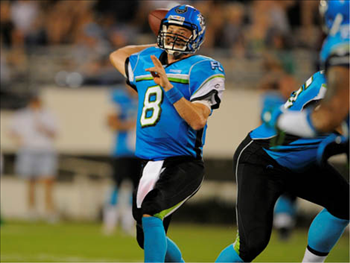
Of course, the downside is that we’d be over-saturating the talent pool a bit—look at the rosters in the United Football League (UFL) and it wouldn’t be surprising to wonder, “Quinn Gray? Isn’t he dead? I thought he died in 2002. Weird.” And the UFL kind of already has a leg up as far as goofy names and logos (although I’m sure you get lots of street cred for wearing a light blue Florida Tuskers cap in downtown Tallahassee these days).
 But I still think that more football can’t help but be fun to watch, especially if we know that it means something (with apologies to the UFL’s championship game, the aptly-named UFL Championship Game…that took some marketing genius). We’d get to see some college stars sharpen their skills before getting tossed into the fires of the NFL. We’d get to see more of the 2009 UFL MVP, Brooks Bollinger, and who wouldn’t want that?
 Seriously though, minor league football is an idea waiting to be realized. I just hope I’m given the proper credit when the time comes.
What, Too Soon For A Team To Be Called The New Orleans Hurricanes?
Speaking of team names, and speaking of MLS, I realized something while watching the MLS All-Star Game this week. And no, my realization was not overwhelming shame brought on by watching the MLS All-Star Game.
As the announcers desperately tried to sell the viewers on the merits of MLS, they would talk about the various teams in the league. At some point, I realized that two of the teams are named after natural disasters that happened in that city. The first one I noticed was the Chicago Fire, which I’ll grant is a cool name, and since the Great Chicago Fire happened nearly 140 years ago, I think it’s a safe enough reference to make.
 But I couldn’t help but Tweet my reaction, and the follow up thoughts about teams and names that reference disasters. Ever full of sarcasm and wit, I wondered if we would see the San Francisco Earthquakes, or the Seattle Volcanoes, or the Louisiana Flood.
Turns out, as I watched more of the telecast, there actually is a team in MLS called the San Jose Earthquakes.
 For one thing, I think a single earthquake is scary enough, but to have to face a team full of earthquakes…that is a contest I’m not prepared to undertake.
Is it just me, or is it a little odd that a team can be named after a disaster that happened just 21 years ago? I remember the San Francisco earthquake of 1989, mostly because it interrupted the World Series, but I still have clear mental pictures of collapsed bridges, chunks of highway uprooted and buildings falling over. This wasn’t that long ago, but it’s open for a team to be named after it?
 My Tweets carry over to Facebook, so I ended up in a bit of a discussion about this phenomenon that circled back to listing a whole lot of borderline-inappropriate team names that MLS should consider. Some of the gems include the Oklahoma Cyclones, the Buffalo Blizzard (an actual team in the now-defunct National Professional Soccer League),
 the Kansas Dustbowls, the South Carolina Confederates, the Dallas Grassy Knolls, and my personal favorite (courtesy of my friend Rick), the Pearl Harbor Attack.
Just to be clear, none of this is meant in a mean spirit or anything—the point is that if it’s OK to have a team named the San Jose Earthquakes just 21 years after the actual earthquake, where do we draw the line?
I’d like to further explain myself by saying that I honestly have no opinion on the matter, I just happened to find it interesting that a team/league would step out and make a decision like this. I don’t have a problem with it—to me, it’s just a team name, and should therefore be taken as such. I could write a whole lot of pages about my thoughts on people who take themselves and everything else too seriously, but I’ll save that for another time.
I guess my curiosity is such that I wonder why a team would even bother to tempt it by using a name that could have any potential negative connotation? On the other hand, part of me wants to congratulate them for taking that kind of a stand, because, as I said, it’s just a team name, and honestly, why should it be taken as anything more? It’s an interesting situation, that’s for sure.
And as I said before, if you have any thoughts on the subject, please e-mail me at sports@valleycenter.com and I’ll be sure to share what you have to say with our readers.
Just be sure to send it in right away, because (as Target keeps reminding me) summer is almost over, and the sports pages will soon be filled with all the football that’s fit to print once again!
To be fair, I’d probably be less than happy with almost all the retailers out there this time of year, because it seems like it gets earlier and earlier every summer that they insist on reminding us that summer is winding down, thanks to a slew of “Back To School!” banners, commercials and ads in the newspaper.
 But for as much fun as summer is when you’re a kid, there’s really not much in it if you’re a sports fan. Sure, there’s baseball, but who wants to watch two guys play catch for three hours (unless it’s a Red Sox-Yankees game, in which case it’s more like four)? NASCAR is going strong, but the summer months feature some of the most boring races (Pocono, Indianapolis, Chicago, Michigan twice... yawn) and The Chase is still more than a month away. Things have gotten so bad that I actually watched a Major League Soccer (MLS) game last week. Let’s just say that MLS is not so exciting after you’ve gotten used to World Cup soccer.
But even in a summer when the weather can’t seem to make up its mind (we just went through San Diego’s coldest July in nearly 100 years), I still had a few random thoughts about sports this week that I would like to share with you.
As always, I would love to hear your thoughts about these, or any, sports-related topic. Send me an e-mail at sports@valleycenter.com anytime and we’ll get a good discussion going.
I’m Sure The Browns Would Still Be Terrible
Watching the World Cup this year was a really fun experience, and I feel like I learned a lot about soccer. If I lived in Europe—or if it didn’t cost an arm and a leg to watch English Premier League (EPL) soccer here in America—then I would probably watch more of the world’s elite soccer players battle it out on the pitch.
One little detail about the EPL that I find fascinating is the idea of relegation.Basically, the Premier League consists of the top 20 soccer teams in England and is affiliated with The Football League, which consists of 72 clubs split evenly between three divisions, The Championship League, League One and League Two.
I suppose the simplest way of putting it is to say that, at the end of each season, each of these four divisions changes teams. The top three teams in the three lower divisions get to move up to the next division, while the bottom three teams from the top three divisions move down. It sounds complicated, but it makes sense.
The idea is that the Premier League is reserved for the teams that are the best of the best, but each team’s spot in this league is not a guarantee. You have to earn your chance to play in the EPL every season.
I absolutely love this idea for other sports. For one thing, you’re not watering down the competition between the good teams by making them have to play pushovers. For another thing, you’re giving teams in rebuilding years a chance to play meaningful games against opponents who are more closely matched in talent, making for more exciting games. It’s the best of both worlds.
Imagine if this concept were to be applied to the NFL. Right now, there are 32 teams in the league, and honestly, it’s not hard to say that 16 of those teams are legitimate, while the other 16 are middle-of-the-road, at best. Take the top 16 teams (according to last year’s standings, the top 16 teams in the league were Indianapolis, New Orleans, San Diego, Minnesota, Green Bay, Dallas, Philadelphia, New England, Cincinnati, Arizona, New York Jets, Baltimore, Atlanta, Pittsburgh, Houston and one of the teams that finished 8-8, which were Carolina, San Francisco, Denver, New York Giants and Tennessee) and separate them into the NFL Division I or something like that. Then put the other 16 teams in Division II and have them play against each other all season. At the end of the year, the bottom three from Division I get sent down, while the top three from Division II move up. It adds more drama to those games at the end of the year, especially for those teams who aren’t going to make the playoffs. More meaningful games are good for all of us.
Of course, the teams that stink wouldn’t be happy about it… at first. But I have a feeling they’d all get used to it, because they’d still be officially in the NFL, they wouldn’t be getting blown out, and they’d have a chance to play for the Division II championship (which could be held the week before the Super Bowl to save us all from the disappointment that is the Pro Bowl) at the end of the season. It’s hard to get excited about a game between the Browns and the Panthers, but if a win meant that one of them got a shot at moving up to Division I, then the intensity gets ratcheted up a notch. Again, how could anyone turn down a chance to see more games that mean something?
 The only potential downside I can see is that it’s hard to get better if you’re not playing against better players. But I think the competition level in the NFL, across the board, is such that even the worst teams in the league still have players who are playing at an elite level. Just because the Rams only won one game last year doesn’t mean that Steven Jackson isn’t a talented running back.
 And with the way that the NFL goes through cycles (remember when the Colts and Patriots were terrible?), I think we would still see those cycles play out like they have in the past. The NFL would have to tweak the draft rules just a bit—perhaps they would have Division II draft first, going in the inverse order of the standings, then have the Division I teams follow after—but I think things wouldn’t change much. A few good players can turn a franchise around, and it can happen at just about any time.
On The Plus Side, We’d Get To See More Of Brooks Bollinger
Another NFL idea I’d like to see put into action is the concept of a minor league farm system, similar to what we have in baseball and hockey.
Each Major League Baseball (MLB) team has a series of minor league teams in the farm system—meaning that if a player on the MLB team gets hurt or traded, the club can “call up” a player from the top minor league team to replace him. Each minor league team is affiliated with an MLB team so the pro team can develop the talent of young players before bringing them up to the big leagues.
 It’s the same in the National Hockey League (NHL), only each NHL team only has one minor league team instead of a whole farm system.
Why hasn’t anyone tried this in the NFL? I guess the popularity of football is still relatively new, and it would be a pretty serious undertaking to get the logistics worked out for the creation of 32 minor league football teams. But I have a feeling that the investment would more than pay off, and I don’t think it takes a genius to get the ball rolling.
Let’s say that we could convince 32 multi-millionaires that it would be totally cool to own your own sports franchise. A stretch, I know, but… we’ll just call it a hypothetical. Anyway, we get 32 rich guys (or gals, there’s nothing wrong with that. Other than still using the term “gals” I mean. I digress.) to pony up enough to pay for players, coaches, uniforms, staff, stadium use and team travel expenses. The league would have to set some kind of a salary cap to keep things reasonable (ideally, you’d want some kind of system that only allows you to pay a certain maximum based on a player’s experience and position on the field), but we’ll skip that for now.
What would be great about the DFL (Developmental Football League)—or whatever it would be called—is that you wouldn’t really have to change much about the structure of the current NFL squad. Each team is allowed to have 80 players on the roster during training camp. Throughout the summer, a series of cuts is made, brining the roster down to the regular season size of 53. Of course, during the season, each team can only have 45 active players dressed for each game. Those eight who are not dressed are the members of the practice squad, or scout team.
If each NFL team had a minor league affiliate, they wouldn’t need to make all those cuts, just a decision about who plays in the big leagues and who gets sent down. Keep those 45 players for the NFL team and you still have 35 left over from the 80 you brought to training camp. And there are always plenty of unsigned free agents out there after the draft, so I don’t think teams would have trouble finding another ten guys who want a shot at playing pro football.
Here’s the genius of the plan, though—because of the popularity of college football, the NFL draft has become a big-time event in and of itself. We want to see where Tim Tebow is going to play his pro ball. We want to know what will happen to Jimmy Clausen, Jahvid Best, C.J. Spiller and Ndomukong Suh.
With a developmental league, these players would all get to play every week, and we’d get to watch their development. Watch Tim Tebow learn to read the cover-two defense. Watch Jahvid Best learn to pick up a pro blitz. It’s riveting.
Plus, if an organization were to be particularly on the ball, you could have a similar system in place for both levels (for example, if the Philadelphia Eagles run a West Coast offense, then their minor league team should also follow suit). It would be a lot like the high school system of varsity and JV, with different coaches following the same system. And something tells me there would be no shortage of coaches who would be more than happy to sign up for this kind of a chance.
Really, the only detail that’s left is to start picking out the names of the minor league teams. I still can’t decide if it would be easier for the teams to play in the same stadium as their NFL counterparts or if they should have their own (nearby) cities. If they used the same stadium, they could just follow the NFL team’s schedule, but reversed (for example, if the Chargers are hosting the Chiefs, then the San Diego Lightning would play at the Kansas City Braves in the minor league matchup).
But, if each team had its own city, we could revitalize some smaller cities and give minor league football its own culture, just like minor league baseball. Each team could come up with something a little wacky (like the Lansing Lugnuts or the Tacoma Rainiers) that’s also specific to that geographic location. Add some crazy logos and you’ve got some fan-friendly football fun ready to take the field.
The other question would be when the minor league teams would play. I say they should play on Friday night so they wouldn’t interfere with college football. You could also make arguments for Wednesday night (a cure for the mid-week, no-football blues) or for Sunday afternoon. I’d be ok with any of these, just as long as we got to see more football.
Of course, the downside is that we’d be over-saturating the talent pool a bit—look at the rosters in the United Football League (UFL) and it wouldn’t be surprising to wonder, “Quinn Gray? Isn’t he dead? I thought he died in 2002. Weird.” And the UFL kind of already has a leg up as far as goofy names and logos (although I’m sure you get lots of street cred for wearing a light blue Florida Tuskers cap in downtown Tallahassee these days).
But I still think that more football can’t help but be fun to watch, especially if we know that it means something (with apologies to the UFL’s championship game, the aptly-named UFL Championship Game…that took some marketing genius). We’d get to see some college stars sharpen their skills before getting tossed into the fires of the NFL. We’d get to see more of the 2009 UFL MVP, Brooks Bollinger, and who wouldn’t want that?Seriously though, minor league football is an idea waiting to be realized. I just hope I’m given the proper credit when the time comes.What, Too Soon For A Team To Be Called The New Orleans Hurricanes?
Speaking of team names, and speaking of MLS, I realized something while watching the MLS All-Star Game this week. And no, my realization was not overwhelming shame brought on by watching the MLS All-Star Game.
As the announcers desperately tried to sell the viewers on the merits of MLS, they would talk about the various teams in the league. At some point, I realized that two of the teams are named after natural disasters that happened in that city. The first one I noticed was the Chicago Fire, which I’ll grant is a cool name, and since the Great Chicago Fire happened nearly 140 years ago, I think it’s a safe enough reference to make.
But I couldn’t help but Tweet my reaction, and the follow up thoughts about teams and names that reference disasters. Ever full of sarcasm and wit, I wondered if we would see the San Francisco Earthquakes, or the Seattle Volcanoes, or the Louisiana Flood.Turns out, as I watched more of the telecast, there actually is a team in MLS called the San Jose Earthquakes.
For one thing, I think a single earthquake is scary enough, but to have to face a team full of earthquakes…that is a contest I’m not prepared to undertake.Is it just me, or is it a little odd that a team can be named after a disaster that happened just 21 years ago? I remember the San Francisco earthquake of 1989, mostly because it interrupted the World Series, but I still have clear mental pictures of collapsed bridges, chunks of highway uprooted and buildings falling over. This wasn’t that long ago, but it’s open for a team to be named after it?
My Tweets carry over to Facebook, so I ended up in a bit of a discussion about this phenomenon that circled back to listing a whole lot of borderline-inappropriate team names that MLS should consider. Some of the gems include the Oklahoma Cyclones, the Buffalo Blizzard (an actual team in the now-defunct National Professional Soccer League),the Kansas Dustbowls, the South Carolina Confederates, the Dallas Grassy Knolls, and my personal favorite (courtesy of my friend Rick), the Pearl Harbor Attack.Just to be clear, none of this is meant in a mean spirit or anything—the point is that if it’s OK to have a team named the San Jose Earthquakes just 21 years after the actual earthquake, where do we draw the line?
I’d like to further explain myself by saying that I honestly have no opinion on the matter, I just happened to find it interesting that a team/league would step out and make a decision like this. I don’t have a problem with it—to me, it’s just a team name, and should therefore be taken as such. I could write a whole lot of pages about my thoughts on people who take themselves and everything else too seriously, but I’ll save that for another time.
I guess my curiosity is such that I wonder why a team would even bother to tempt it by using a name that could have any potential negative connotation? On the other hand, part of me wants to congratulate them for taking that kind of a stand, because, as I said, it’s just a team name, and honestly, why should it be taken as anything more? It’s an interesting situation, that’s for sure.
And as I said before, if you have any thoughts on the subject, please e-mail me at sports@valleycenter.com and I’ll be sure to share what you have to say with our readers.
Just be sure to send it in right away, because (as Target keeps reminding me) summer is almost over, and the sports pages will soon be filled with all the football that’s fit to print once again!
VCHS Fall Tryouts Schedule
Valley Center High School – Jaguar Athletics
Fall Tryout Schedule 2010
You must turn in a sports clearance form to the office before participating in tryouts!
Boys/Girls Cross Country
Starting, Monday, August 16th 6:30am-8:30am at the track
Girls Field Hockey
Starting Monday, August 16th 7:00-10:00am
At grass field hockey field/JV baseball field
JV/Varsity Football
Thursday, August 12th pick up gear: Var /9:00am JV /9:30am Practice 3:00-5:00pm
Friday, August 13th: 8:00-11:00am and 2:00- 5:00pm
Saturday, August 14th 8:00-10:00am
Frosh Football
Thursday, August 12th pick up gear: 10:00am 11:30-1:30PM
Practice Friday, August 13th 8:00-12 noon
Saturday, August 14th 8:00-10am
Girls Golf
August 16th-19th _ All levels 9:00-10:30am at Woods Valley Golf Course
August 23rd and 24th 3:00-5:00pm
Girls Tennis
Starting Monday, August 16th 3:00-5:00pm at Adams Park
Girls Volleyball
Monday, August 16th – All Levels 3:00-6:00pm in VCHS gym
Tues-Thurs, August 17th-19th Frosh 2:00-4:00pm Var/JV 4:00-6:30pm
Boys Water Polo
Starting Monday, August 16th at Adams Park
Varsity: 6:00-7:30am and 4:00-6:00pm
JV/Novice: 6:00-8:00pm
Note: Once practice begins, practices will be daily.
Each coach will distribute additional time schedules for the remainder of the season.
Note: All athletes must be cleared before they can tryout for a team.
Athletic Clearance Packets are available at the VCHS front office starting August 2nd. A printable version of the packet is available on the Valley Center High School web site. Completed packets that contain proof of a recent physical, proof of insurance, all signatures signed, and all information filled out must be turned into the athletic director’s office before an athlete can try out for a team.
There will be a Sports Clearance Night at the high school on Monday, August 10th, starting at 6:00 pm. Cost is $30 for a physical. Parents must attend physical night with their son/daughter. You may get a physical from another doctor, but you must use the form that is in the clearance packet.
Fall Tryout Schedule 2010
You must turn in a sports clearance form to the office before participating in tryouts!
Boys/Girls Cross Country
Starting, Monday, August 16th 6:30am-8:30am at the track
Girls Field Hockey
Starting Monday, August 16th 7:00-10:00am
At grass field hockey field/JV baseball field
JV/Varsity Football
Thursday, August 12th pick up gear: Var /9:00am JV /9:30am Practice 3:00-5:00pm
Friday, August 13th: 8:00-11:00am and 2:00- 5:00pm
Saturday, August 14th 8:00-10:00am
Frosh Football
Thursday, August 12th pick up gear: 10:00am 11:30-1:30PM
Practice Friday, August 13th 8:00-12 noon
Saturday, August 14th 8:00-10am
Girls Golf
August 16th-19th _ All levels 9:00-10:30am at Woods Valley Golf Course
August 23rd and 24th 3:00-5:00pm
Girls Tennis
Starting Monday, August 16th 3:00-5:00pm at Adams Park
Girls Volleyball
Monday, August 16th – All Levels 3:00-6:00pm in VCHS gym
Tues-Thurs, August 17th-19th Frosh 2:00-4:00pm Var/JV 4:00-6:30pm
Boys Water Polo
Starting Monday, August 16th at Adams Park
Varsity: 6:00-7:30am and 4:00-6:00pm
JV/Novice: 6:00-8:00pm
Note: Once practice begins, practices will be daily.
Each coach will distribute additional time schedules for the remainder of the season.
Note: All athletes must be cleared before they can tryout for a team.
Athletic Clearance Packets are available at the VCHS front office starting August 2nd. A printable version of the packet is available on the Valley Center High School web site. Completed packets that contain proof of a recent physical, proof of insurance, all signatures signed, and all information filled out must be turned into the athletic director’s office before an athlete can try out for a team.
There will be a Sports Clearance Night at the high school on Monday, August 10th, starting at 6:00 pm. Cost is $30 for a physical. Parents must attend physical night with their son/daughter. You may get a physical from another doctor, but you must use the form that is in the clearance packet.
VC Avengers Take Second In Escondido Rugby Tournament
(story by Ben Everett, photos by Teresa Everett)
 The Valley Center Avengers
Back row (left to right): Coach Dale Turori, Caleb Segina, Chris Turori, Erik Brinkman, John Turori, Alex Carr, Lance Armstrong. Front row: Ben Everett, Jason Throop, Jake Jennings, Garret Fiehler, coach George Turori
Saturday was a triumphant send-off for the Valley Center Avengers, as our town’s recently assembled Under 19 rugby team compiled a 3–1 record en route to a second place finish at their final tournament of the season.
The Escondido competition, which was the third such event in team history, provided an opportunity for the Avengers to showcase their marked improvement since finishing two previous summer tourneys with a combined record of 2–4.
Valley Center’s performance proved especially encouraging, considering that nearly the entire team had first picked up a rugby ball not six weeks ago, and all are young enough to return next year for what promises to be a rousing season of rugby sevens.
Because the traditional and more easily recognizable form of rugby, which is a bruising game involving 15 players per team and plenty of physicality to complement the sport’s finesse, takes place during the winter or spring, summer is an off-season of sorts among the rugby community.
To fill the void, rugby sevens was created, an offshoot which retains all of rugby’s basic principles, but features only seven players playing seven-minute halves on a pitch larger than a football field, which naturally makes for a fast-paced, fluid game.
On Saturday, the Avengers opened the action against the Del Mar Heights Mustangs, a team whom they had seen excel at various tournaments but had never themselves played. The game began well enough for Valley Center, who received the opening kickoff and, one pass and several broken tackles later, saw captain John Turori score the day’s first try (rugby’s method of scoring, nearly equivalent to a touchdown in both point value and basic concept). The Avengers added to their advantage later in the half when Turori once again collected a pass near the sideline and, with a hop, skip, and a stiff arm, was across the try line for another score. Not surprisingly, the Mustangs showed themselves unwilling to go down quietly by beginning a penetrating drive through the heart of Valley Center’s defense just before the break and bringing the deficit down to seven. Their momentum continued to build just after the opening whistle of the second period, when a Del Mar player turned the corner on an Avenger and sprinted 50 yards for the equalizing try. Although Valley Center looked to be the better team, a disappointing loss loomed on the horizon until a stellar display of selfless ball movement and a patient, persistent attack led to Alex Carr sprinting past three desperate Mustang defenders on his way to the go ahead try. The seven point lead proved to be plenty for Valley Center, whose re-energized defense stifled any opposing scoring efforts for the remaining minutes and allowed the Avengers to walk away with a 21-14 victory.
Having begun the day on a high note, Valley Center turned their attention to their next opponent, the San Pasqual Barbarians, the tournament hosts and a squad with many ties to the Avengers. What with the many friendships and shared jerseys, the game was almost nothing more than a high-stakes scrimmage, epitomizing the sportsmanship and camaraderie which is perhaps rugby’s most essential element. After volunteering to wear their uniforms inside-out, Valley Center took the field and immediately made their presence felt, taking an early lead on Ben Everett’s breakaway down the sideline. While the Avengers’ defense remained strong, an injury towards the middle of the half left them undermanned on the outside, where a Barbarian ballcarrier found a path to the try zone and seven valuable points. The game would not stay tied for long, though, because the ensuing kickoff fell straight into the waiting hands of John Turori, who booted the ball back upfield, sprinted past San Pasqual’s defenders, and grabbed it again for a try (while you cannot pass the ball forwards in rugby, kicking in any direction is allowed, and often taken advantage of by the soccer-happy Avengers). Once again, the Barbarians would answer back, as a rare defensive mistake on the part of Valley Center and a bit of luck allowed them to tie the game up before halftime.
That try would prove to be San Pasqual’s last, but the Avengers needed only a minute to leave their mark on the second half, taking the lead for the final time when Scott Bergquist stole possession from an opponent’s lineout (akin to soccer’s throw-in) and singlehandedly powered his way across the try line. The rest of the game gave way alternatively to sloppy offense and exemplary defense from both sides, but in the end, Valley Center’s scrappy intensity was enough to secure the win for them, 17-10. The Avengers knew, however, that they would need to be nearly perfect to beat their next opponent, the Santa Clarita Tigers.
The Tigers were a team equally blessed with physicality and experience, and who had thoroughly dominated an Ocean Beach tournament last Saturday in which Valley Center finished squarely in the middle. While it was heartening to see just how much the Avengers had improved since then, their prospects looked bleak against a team who had at least quadrupled their opponents’ score in each of their other four games while resting their starters in the second half. Nevertheless, Valley Center entered the game with high hopes and, perhaps to everyone’s surprise but their own, dominated possession for most of the first half. Their momentum came to an abrupt halt, however, when an apparent try was called back on account of the referee neglecting to award the Avengers advantage– leeway to continue play even after the opponent has committed a foul if it benefits your team. The call gave the Tigers the respite needed to return to top form, and the remainder of the first half played out as a thoroughly entertaining display of rugby between two evenly matched teams, which, regardless of the final result, was success enough for the young and inexperienced Valley Center side. The period turned out to be less successful on paper, unfortunately, as Santa Clarita managed to sneak in a try in the half’s waning seconds, leaving the Avengers with a 7-0 deficit to overcome in the final seven minutes.
That deficit had Valley Center hoping for a sudden spark of offense, but the second half picked up where its predecessor left off- plenty of flashy running, efficient passing, and hard-nosed defense, but little progress down the field for either team. The familiarity continued to haunt Valley Center when the period’s turning point again came in the form of a referee’s error- one of two such mistakes in an otherwise very well-officiated game. The fateful play began when John Turori sent a kick downfield, but was beat to the ball by a Santa Clarita defender. Sensing Turori’s impending approach, the Tiger booted the ball out of play behind his own try zone (the namesake and contemporary of football’s end zone). Because he was clearly outside his try zone at the time, the correct restart would have involved a Valley Center scrum five meters from Santa Clarita’s try line (best resembling a face-off in hockey, scrums are how the game is restarted after certain penalties, and consist of three players from either team attempting to push the opposing side off the ball, which is rolled into the middle of the scrum by a player whose team did not commit the infraction). Whether by faulty vision or a misunderstanding of the rules, the referee instead awarded the Tigers complete possession 22 meters from their try line, an action which should have been taken only if the player had been inside his try zone when he cleared the ball. While the Avengers assembled for a scrum, Santa Clarita quickly began play on the opposite side of the field, where they enjoyed a four on one breakaway and scored the try which would ice the game away. Valley Center used the play as fuel for a renewed and relentless attack, but the Tigers’ 14 point lead permitted them to focus entirely on defense, and despite their opponents’ best efforts, they allowed only a late score from Alex Carr. Following on the heels of several near-breakaways and enough hustle to satisfy a legion of coaches, the try was certainly well-earned, but it was not enough to prevent a 5-14 loss. It was a game whose entire story cannot be told by its final score, however, and the Avengers left the field with their heads held high, satisfied with their level of play and with the tantalizing possibility of what may have been were it not for several costly mishaps.
If Valley Center’s last opponent had been the Yankees, their fourth and final game came against what might be called the Bad News Bears. The La Quinta Outlaws out of Palm Springs had fielded a team much younger and less battle-tested than even the Avengers, and, while truly not lacking in talent or tenacity, entered their match against Valley Center having lost their previous four games by hefty margins. The Avengers opened the scoring less than a minute into the game, when Jason Throop dashed around the end of La Quinta’s defense for his first try of the day. Valley Center, intent to put the game away early, quickly followed with another try from John Turori, whose vicious stiff arms had left him with only one good shoulder, but still remained nearly unstoppable. The Outlaws took the kickoff and began to assert themselves, holding possession for much of the remainder of the half and advancing within yards of Valley Center’s try zone. The attacks provided no tangible results for La Quinta, however, and the Avengers soon took back control of the game and ended the half with a try from Scott Bergquist straight through the middle of the field.
Valley Center’s dominance continued through the second half, as a series of punishing runs off of the opening kick advanced the ball within spitting distance of La Quinta’s try zone, where Bergquist soon scored his second try of the game. Their 28 point lead began to take the spring out of the Avengers’ step, as those things tend to do, and the opportunistic Outlaws responded with two quick tries to cut the lead in half and add a touch of suspense to the game. The drama, as might be suspected, was done away with in short notice by Valley Center, who regained their focus and once again saw Jason Throop outstrip every La Quinta defender behind him to score the tournament’s final try. The Avengers’ 35-14 lead was held until the final whistle, which, as the competition featured no bracket-style finals, made Valley Center’s second place finish official.
It was a fitting end to a season for the Avengers, whose improvement from week to week and even from game to game was visible throughout the day. While they did not win the tournament, their lofty finish put the team emphatically on the radar of every youth rugby club in San Diego who must contend with an older, adepter Valley Center squad during next year’s season. The team will first look to this winter, however, when the traditional rugby season begins and players, parents, and coaches hope to have begun our very own high school aged club. If you are interested in becoming a part of this exciting venture, or simply want to give the sport a try, coach George Turori and the rest of the Avengers will be holding free clinics throughout the fall to garner interest for the team and introduce young Valley Center athletes to the wonders of rugby. Look to future editions of The Roadrunner for more information.
John Turori fends off a tackler:
 Scott Bergquist leaves his defenders winded after a long run for a try:
 Jason Throop uses his speed to outrun a defender:
 John Turori uses the stiff-arm to break another tackle:
 John Turori prepares to pass before the defense closes in:
 John Turori closes in on the Tigers' winger:
 Jason Throop zeroes in on a tackle:
 Jason Throop uses his speed to score a breakaway try:
 John Turori breaks a tackle on his way to a try:
 Garrett Fiehler swoops in for a tackle, as teammate Alex Carr looks on:
 John Turori advances the ball by kicking it downfield:
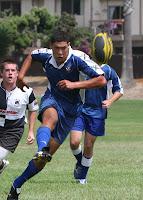 Garrett Fiehler turns the corner on a defender:
 Chris Turori wins the ball after a tough tackle:
 Erik Brinkman powers through a tackle:
 Alex Carr stretches to win a line in:
 VC captain John Turori breaks away on his way to his first try of the tournament:


 The Valley Center Avengers
Back row (left to right): Coach Dale Turori, Caleb Segina, Chris Turori, Erik Brinkman, John Turori, Alex Carr, Lance Armstrong. Front row: Ben Everett, Jason Throop, Jake Jennings, Garret Fiehler, coach George Turori
Saturday was a triumphant send-off for the Valley Center Avengers, as our town’s recently assembled Under 19 rugby team compiled a 3–1 record en route to a second place finish at their final tournament of the season.
The Escondido competition, which was the third such event in team history, provided an opportunity for the Avengers to showcase their marked improvement since finishing two previous summer tourneys with a combined record of 2–4.
Valley Center’s performance proved especially encouraging, considering that nearly the entire team had first picked up a rugby ball not six weeks ago, and all are young enough to return next year for what promises to be a rousing season of rugby sevens.
Because the traditional and more easily recognizable form of rugby, which is a bruising game involving 15 players per team and plenty of physicality to complement the sport’s finesse, takes place during the winter or spring, summer is an off-season of sorts among the rugby community.
To fill the void, rugby sevens was created, an offshoot which retains all of rugby’s basic principles, but features only seven players playing seven-minute halves on a pitch larger than a football field, which naturally makes for a fast-paced, fluid game.
On Saturday, the Avengers opened the action against the Del Mar Heights Mustangs, a team whom they had seen excel at various tournaments but had never themselves played. The game began well enough for Valley Center, who received the opening kickoff and, one pass and several broken tackles later, saw captain John Turori score the day’s first try (rugby’s method of scoring, nearly equivalent to a touchdown in both point value and basic concept). The Avengers added to their advantage later in the half when Turori once again collected a pass near the sideline and, with a hop, skip, and a stiff arm, was across the try line for another score. Not surprisingly, the Mustangs showed themselves unwilling to go down quietly by beginning a penetrating drive through the heart of Valley Center’s defense just before the break and bringing the deficit down to seven. Their momentum continued to build just after the opening whistle of the second period, when a Del Mar player turned the corner on an Avenger and sprinted 50 yards for the equalizing try. Although Valley Center looked to be the better team, a disappointing loss loomed on the horizon until a stellar display of selfless ball movement and a patient, persistent attack led to Alex Carr sprinting past three desperate Mustang defenders on his way to the go ahead try. The seven point lead proved to be plenty for Valley Center, whose re-energized defense stifled any opposing scoring efforts for the remaining minutes and allowed the Avengers to walk away with a 21-14 victory.
Having begun the day on a high note, Valley Center turned their attention to their next opponent, the San Pasqual Barbarians, the tournament hosts and a squad with many ties to the Avengers. What with the many friendships and shared jerseys, the game was almost nothing more than a high-stakes scrimmage, epitomizing the sportsmanship and camaraderie which is perhaps rugby’s most essential element. After volunteering to wear their uniforms inside-out, Valley Center took the field and immediately made their presence felt, taking an early lead on Ben Everett’s breakaway down the sideline. While the Avengers’ defense remained strong, an injury towards the middle of the half left them undermanned on the outside, where a Barbarian ballcarrier found a path to the try zone and seven valuable points. The game would not stay tied for long, though, because the ensuing kickoff fell straight into the waiting hands of John Turori, who booted the ball back upfield, sprinted past San Pasqual’s defenders, and grabbed it again for a try (while you cannot pass the ball forwards in rugby, kicking in any direction is allowed, and often taken advantage of by the soccer-happy Avengers). Once again, the Barbarians would answer back, as a rare defensive mistake on the part of Valley Center and a bit of luck allowed them to tie the game up before halftime.
That try would prove to be San Pasqual’s last, but the Avengers needed only a minute to leave their mark on the second half, taking the lead for the final time when Scott Bergquist stole possession from an opponent’s lineout (akin to soccer’s throw-in) and singlehandedly powered his way across the try line. The rest of the game gave way alternatively to sloppy offense and exemplary defense from both sides, but in the end, Valley Center’s scrappy intensity was enough to secure the win for them, 17-10. The Avengers knew, however, that they would need to be nearly perfect to beat their next opponent, the Santa Clarita Tigers.
The Tigers were a team equally blessed with physicality and experience, and who had thoroughly dominated an Ocean Beach tournament last Saturday in which Valley Center finished squarely in the middle. While it was heartening to see just how much the Avengers had improved since then, their prospects looked bleak against a team who had at least quadrupled their opponents’ score in each of their other four games while resting their starters in the second half. Nevertheless, Valley Center entered the game with high hopes and, perhaps to everyone’s surprise but their own, dominated possession for most of the first half. Their momentum came to an abrupt halt, however, when an apparent try was called back on account of the referee neglecting to award the Avengers advantage– leeway to continue play even after the opponent has committed a foul if it benefits your team. The call gave the Tigers the respite needed to return to top form, and the remainder of the first half played out as a thoroughly entertaining display of rugby between two evenly matched teams, which, regardless of the final result, was success enough for the young and inexperienced Valley Center side. The period turned out to be less successful on paper, unfortunately, as Santa Clarita managed to sneak in a try in the half’s waning seconds, leaving the Avengers with a 7-0 deficit to overcome in the final seven minutes.
That deficit had Valley Center hoping for a sudden spark of offense, but the second half picked up where its predecessor left off- plenty of flashy running, efficient passing, and hard-nosed defense, but little progress down the field for either team. The familiarity continued to haunt Valley Center when the period’s turning point again came in the form of a referee’s error- one of two such mistakes in an otherwise very well-officiated game. The fateful play began when John Turori sent a kick downfield, but was beat to the ball by a Santa Clarita defender. Sensing Turori’s impending approach, the Tiger booted the ball out of play behind his own try zone (the namesake and contemporary of football’s end zone). Because he was clearly outside his try zone at the time, the correct restart would have involved a Valley Center scrum five meters from Santa Clarita’s try line (best resembling a face-off in hockey, scrums are how the game is restarted after certain penalties, and consist of three players from either team attempting to push the opposing side off the ball, which is rolled into the middle of the scrum by a player whose team did not commit the infraction). Whether by faulty vision or a misunderstanding of the rules, the referee instead awarded the Tigers complete possession 22 meters from their try line, an action which should have been taken only if the player had been inside his try zone when he cleared the ball. While the Avengers assembled for a scrum, Santa Clarita quickly began play on the opposite side of the field, where they enjoyed a four on one breakaway and scored the try which would ice the game away. Valley Center used the play as fuel for a renewed and relentless attack, but the Tigers’ 14 point lead permitted them to focus entirely on defense, and despite their opponents’ best efforts, they allowed only a late score from Alex Carr. Following on the heels of several near-breakaways and enough hustle to satisfy a legion of coaches, the try was certainly well-earned, but it was not enough to prevent a 5-14 loss. It was a game whose entire story cannot be told by its final score, however, and the Avengers left the field with their heads held high, satisfied with their level of play and with the tantalizing possibility of what may have been were it not for several costly mishaps.
If Valley Center’s last opponent had been the Yankees, their fourth and final game came against what might be called the Bad News Bears. The La Quinta Outlaws out of Palm Springs had fielded a team much younger and less battle-tested than even the Avengers, and, while truly not lacking in talent or tenacity, entered their match against Valley Center having lost their previous four games by hefty margins. The Avengers opened the scoring less than a minute into the game, when Jason Throop dashed around the end of La Quinta’s defense for his first try of the day. Valley Center, intent to put the game away early, quickly followed with another try from John Turori, whose vicious stiff arms had left him with only one good shoulder, but still remained nearly unstoppable. The Outlaws took the kickoff and began to assert themselves, holding possession for much of the remainder of the half and advancing within yards of Valley Center’s try zone. The attacks provided no tangible results for La Quinta, however, and the Avengers soon took back control of the game and ended the half with a try from Scott Bergquist straight through the middle of the field.
Valley Center’s dominance continued through the second half, as a series of punishing runs off of the opening kick advanced the ball within spitting distance of La Quinta’s try zone, where Bergquist soon scored his second try of the game. Their 28 point lead began to take the spring out of the Avengers’ step, as those things tend to do, and the opportunistic Outlaws responded with two quick tries to cut the lead in half and add a touch of suspense to the game. The drama, as might be suspected, was done away with in short notice by Valley Center, who regained their focus and once again saw Jason Throop outstrip every La Quinta defender behind him to score the tournament’s final try. The Avengers’ 35-14 lead was held until the final whistle, which, as the competition featured no bracket-style finals, made Valley Center’s second place finish official.
It was a fitting end to a season for the Avengers, whose improvement from week to week and even from game to game was visible throughout the day. While they did not win the tournament, their lofty finish put the team emphatically on the radar of every youth rugby club in San Diego who must contend with an older, adepter Valley Center squad during next year’s season. The team will first look to this winter, however, when the traditional rugby season begins and players, parents, and coaches hope to have begun our very own high school aged club. If you are interested in becoming a part of this exciting venture, or simply want to give the sport a try, coach George Turori and the rest of the Avengers will be holding free clinics throughout the fall to garner interest for the team and introduce young Valley Center athletes to the wonders of rugby. Look to future editions of The Roadrunner for more information.
John Turori fends off a tackler:
 Scott Bergquist leaves his defenders winded after a long run for a try:
 Jason Throop uses his speed to outrun a defender:
 John Turori uses the stiff-arm to break another tackle:
 John Turori prepares to pass before the defense closes in:
 John Turori closes in on the Tigers' winger:
 Jason Throop zeroes in on a tackle:
 Jason Throop uses his speed to score a breakaway try:
 John Turori breaks a tackle on his way to a try:
 Garrett Fiehler swoops in for a tackle, as teammate Alex Carr looks on:
 John Turori advances the ball by kicking it downfield:
 Garrett Fiehler turns the corner on a defender:
 Chris Turori wins the ball after a tough tackle:
 Erik Brinkman powers through a tackle:
 Alex Carr stretches to win a line in:
 VC captain John Turori breaks away on his way to his first try of the tournament:


You Can't Surf In A Hurricane

On Monday, the Valley Center Hurricane girls U14 team defeated the San Diego Surf in an overtime penalty kick shootout for their first tournament win this year, behind the slogan, “You can’t surf in a hurricane!” The Hurricanes started the tournament with a 2–1 loss to the same Surf team on Saturday morning. They went on to defeat the hosting Del Mar Sharks 1–0 later that day, then downed the Pumas of Chula Vista 5–0 on Sunday to qualify for the Monday morning final match. Their next action will be in the Dave Shelton Tournament Aug. 13–15.
The Hurricanes are: Sloane Adams, Bianca Bilotta, Brianna Bilotta, Madison Calbert, Raquel Cifuentes, Brianna Darnell, Brienna Dunckel, Brittany Dunckel, Helen Lopez, Annika Odeen, Clara Padinske, Savanna Reilly, Alexis Reyes, Madison Sanders, Emily Tuttle, Emily Venisse, Nicole Venisse and Liena Villemez, with coaches Bill Dunckel and Paul Venisse.

Subscribe to:
Posts (Atom)