Showing posts with label minor. Show all posts

Wednesday, January 5, 2011

I Kid You Not: forget resolutions, what can sports do for us this year?

The beginning of a new year can serve as a reminder of the ever-changing nature of our world. The old is gone, the new has come.
And so many of us take this opportunity to take stock in our lives; to re-evaluate what’s important, to learn from the experiences of the past year, and, if possible, to make plans for improvement in the year to come.
This is not what I will be doing this year.
Operating under the assumption that I’m pretty great already, I’ve decided that the world should be making resolutions to make my life better.
Specifically, I’ve decided that the sports world should make a few changes.
A couple of years ago, I wrote a list of sports-related resolutions that I wanted to implement. I wanted to watch more games (which I’ve done), go to more games in person (also done),
...root for a team over an individual (sorry, Miami Dolphins players, but my fantasy football team did much better without any of you in my starting lineup), wear real eye black (which was confused for mascara by a scorekeeper in my coed softball league last year)
...and in general, have more fun with sports.
After months of introspection (or five minutes watching Sportscenter), it became clear that A) I’m pulling my weight around here, and B) the sports world is not.
So what should the world of sports do to better appease me?
I’m glad you asked.
1. Quality Over Quantity
512. 4,860. 2,460. Another 2,460. 36. Add those all together and you get 10,328.
That’s how many major sports competitions are held every year, just in the regular season. 512 NFL games, 4,860 MLB games, 2,460 games in both the NBA and NHL, and 36 NASCAR races. If we say that the average length of each of these contests is around three hours, that’s 30,984 hours of major sports action every single year.
There are only 8,766 hours in a year, so since many of these games are going on simultaneously, the number will be higher.
But my goodness, 30,984 hours of sports? I’m a big sports fan, but even that seems like a little bit too much time. Some games are fantastic, and more than worth the three-ish hours we put in. Others involve the Milwaukee Brewers, and shouldn’t be shown to small children.
I’ve written before about how the NFL has it right—one game per team per week, 16 games in the regular season, three weeks of playoffs, then the Super Bowl. Just enough to keep us interested, but not too much that we get bored. Because let’s face it, Americans get bored really easily. What used to be called multitasking a few years ago is now just called “tasking.” We watch TV while we eat. We talk on the phone while we drive (um… with a hands-free device, of course). We watch more TV while we… um… sleep.
I’m just as guilty as the next person. In our home, my wife and I have three TVs (one of which looks like this),
...four video game systems, two computers and three cell phones, two of which are “smart” phones. Not counting my collection of old Hardy Boys books (I’m a sucker for kitsch), our DVD collection outnumbers our book collection (not as much as it used to before I got married, at least). I recently chuckled to myself as I noticed another person watching TV, listening to an MP3 player and playing Mario Kart on the computer, all at the same time. Needless to say, we live in a country that takes sensory input to levels never before imagined.
But as we discussed in the NFL-has-it-right column, more is definitely not always better. Baseball is fun to watch, but it’s easy to lose interest in a team when you can’t watch 162 games. Same with the NBA, NHL and NASCAR (as much as I love NASCAR, it’s just too long of a season). And now the NFL is talking about an 18-game schedule for next year. Really? I mean, I know football is America’s current pastime, but as ESPN.com writer Gregg Easterbrook consistently reminds us, there is no law that says football has to remain popular.
I know it’s a lot to ask, but I think the sports world owes us less quantity and more quality. If it means contracting a few teams in the NBA and NHL and scaling back to 40 games or so (from December through March or something like that), then let’s do it. If it means only playing baseball in the summer (the horror!) instead of spring-to-winter, then let’s whittle the schedule down to June, July and August, with the playoffs in September. If it means only running NASCAR races from February through August, so as not to overlap the NFL, I’m all for it.
Basically, I want to be able to enjoy the sports I get to watch. I want games to mean something. I want each sport to have its own season of the year, with the exception of basketball, which is boring and should be ignored while we watch hockey.
I want sports to be worth watching in the 8,766 hours I have this year.
2. More Football!
I know, this one seems to contradict the last one, but really, when you think about it… OK so it contradicts the last one. This is my wish list so I can contradict whatever I want.
I know it’s a long shot, but I’d really like to see steps toward the implementation of a Minor League Football system.
I outlined this idea in depth back in August—basically, you take the 32 NFL teams, give each of them a minor league affiliate in a nearby city, and have the minor league team supplement the NFL team’s roster when necessary. Wow, that was much easier to explain this time around. Makes me wonder why I needed 1,100 words to discuss it last time around.
I guess it was to talk about the details of how it would work, not to mention to suggest some fun names for the minor league affiliates (admit it, you’d go see a team called the Escondido Spark Plugs or the Fort Lauderdale Manatees).
This time, I’d like to focus on how it would make being a sports fan better. We all like football, because this is America, and if you don’t, well… you might be a communist. Just saying.
So how could more football not be a good idea?
The risk, as we touched on in the last section, is over-saturation. Too much football could make it seem ho-hum and watered-down.
But the potential reward is intriguing. If each NFL team had a farm team it could use to groom young players, the quality of play in the NFL would go up because young players would get more game experience in the minor league before getting shoved into NFL action. Players who were stars in college would get to quickly show whether or not they belong in the big leagues, while scrappy players who weren’t highly drafted would have more shots to show how their hard work has paid off. And it would even give players returning from injury a chance to play a real game as a bit of a warm-up to coming back to the NFL.
From a fan’s perspective, Minor League Football would give us more opportunities to watch professional-caliber football, play more (or different types of) fantasy football, buy more gear, attend more games (hopefully with the fun-first atmosphere of Minor League Baseball) and see more young players play in real games.
3. Cleaning House
If the world of sports really wants to appease the fans, the key is quality. And the best way to ensure that a quality product hits the field, court, rink or track is by increasing the level of competition while limiting the number of spots available to elite athletes.
In the case of professional sports, I really like the format of the English Premiere League, in which soccer teams are relegated to a lower league if they finish in the bottom four spots in the standings at the end of the season.
For the four major American sports, this would mean splitting the leagues into two levels and allowing only the teams in the top level to compete for the major league championship. In the case of the NFL, if we were to take the top 16 teams in the league (by record) and split them in half, we could separate the teams who are good from the teams who are not. We would have good teams facing good teams on a regular basis, and we wouldn’t have to sit through blowouts like we saw between the Steelers and the Browns on Sunday. Seriously, Cleveland? 41–9? Is that whole LeBron thing still getting to you?
Some might argue that this idea is flawed because we would still have to watch games like the Cardinals against the 49ers. That is true; terrible teams would still be terrible. We can’t get around that. But at least the terrible teams would only be playing other terrible teams, and they would be playing for some sort of second-rate championship, not to mention the chance to move up to the big leagues and play for the real title.
If we don’t get relegation, I’d at least like to see some form of contraction, especially in the NHL. I really like hockey, but there are 30 teams in the NHL, and I don’t think I can name more than one or two players on most of them anymore. And that’s kind of a shame since hockey names are pretty much the best. Where else can you find a guy named Guillaume Latendresse or Georges Laraque or Radek Bonk? Probably not even in the NHL anymore since it’s pretty well impossible to find a hockey game on TV these days.
But if the league went back to 15 teams (half of its current number)—preferably in the colder regions of North America— to consolidate talent, then slashed the schedule down to one or two games per team per week, it would make each game more important and full of better talent. And that’s the goal of this whole thing—more important games with more talent.
4. More Gus Johnson
Pro sports commentators are a dying breed.
Well, we’re losing most of the good ones, anyway. Pat Summerall was an icon. Keith Jackson made a highlight out of introducing the starting lineups. Dick Enberg and his trademark “Oh my!” provided so many great moments.
Bob Papa and Matt Millen, however, do not fall into this category. The NFL Network commentators are just two of the host of insufferable game callers who are increasingly harder to stomach. They all use too many clichéd catchphrases (“When you talk about the Chargers, you talk about a team that really plays well in December.”), too many incorrect words (it’s not, “They’re having a tough time figuring out how to defense the pass,” the correct phrase is, “They’re having a tough time figuring out how to defend the pass.” Don’t try to get all fancy on us.), and too many weird versions of common phrases that nobody else seems to be using (as in, when did “hand-eye coordination” become “eye-hand coordination?”).
At least we have Gus Johnson.

The CBS play-by-play guy has developed a reputation this season for calling the NFL games with the most thrilling finishes. He called the Jaguars/Texans game that ended with a Hail Mary touchdown on the final play and inspired ESPN.com writer Bill Simmons to incorporate Johnson into his many theories about how to predict the winner in NFL games. He’s even the commentator on Madden 11, which is a huge upgrade from Tom Hammond in the 2010 version of the game.
If we cut back on the length of the various sports’ seasons, then we can get Johnson calling games year round. And if that doesn’t make sports more enjoyable, then I don’t know what will.
But maybe you do.
If you have any ideas about what the sports world can do to make 2011 better for us, the fans, send them to me at sports@valleycenter.com and I’ll share them with our readers. You can send an itemized list, a couple of ideas, or just random scribblings on a napkin. Whatever you’ve got, send it in and we’ll do our best to make 2011 a great year for sports.

Tuesday, August 3, 2010

I Kid You Not: Football, Soccer & Teams With Disasters For Names

If I were 12 years old, I would be pretty upset with the Target Corporation.
To be fair, I’d probably be less than happy with almost all the retailers out there this time of year, because it seems like it gets earlier and earlier every summer that they insist on reminding us that summer is winding down, thanks to a slew of “Back To School!” banners, commercials and ads in the newspaper.
But for as much fun as summer is when you’re a kid, there’s really not much in it if you’re a sports fan. Sure, there’s baseball, but who wants to watch two guys play catch for three hours (unless it’s a Red Sox-Yankees game, in which case it’s more like four)? NASCAR is going strong, but the summer months feature some of the most boring races (Pocono, Indianapolis, Chicago, Michigan twice... yawn) and The Chase is still more than a month away. Things have gotten so bad that I actually watched a Major League Soccer (MLS) game last week. Let’s just say that MLS is not so exciting after you’ve gotten used to World Cup soccer.
But even in a summer when the weather can’t seem to make up its mind (we just went through San Diego’s coldest July in nearly 100 years), I still had a few random thoughts about sports this week that I would like to share with you.
As always, I would love to hear your thoughts about these, or any, sports-related topic. Send me an e-mail at sports@valleycenter.com anytime and we’ll get a good discussion going.

I’m Sure The Browns Would Still Be Terrible
Watching the World Cup this year was a really fun experience, and I feel like I learned a lot about soccer. If I lived in Europe—or if it didn’t cost an arm and a leg to watch English Premier League (EPL) soccer here in America—then I would probably watch more of the world’s elite soccer players battle it out on the pitch.
One little detail about the EPL that I find fascinating is the idea of relegation.
Basically, the Premier League consists of the top 20 soccer teams in England and is affiliated with The Football League, which consists of 72 clubs split evenly between three divisions, The Championship League, League One and League Two.
I suppose the simplest way of putting it is to say that, at the end of each season, each of these four divisions changes teams. The top three teams in the three lower divisions get to move up to the next division, while the bottom three teams from the top three divisions move down. It sounds complicated, but it makes sense.
The idea is that the Premier League is reserved for the teams that are the best of the best, but each team’s spot in this league is not a guarantee. You have to earn your chance to play in the EPL every season.
I absolutely love this idea for other sports. For one thing, you’re not watering down the competition between the good teams by making them have to play pushovers. For another thing, you’re giving teams in rebuilding years a chance to play meaningful games against opponents who are more closely matched in talent, making for more exciting games. It’s the best of both worlds.
Imagine if this concept were to be applied to the NFL. Right now, there are 32 teams in the league, and honestly, it’s not hard to say that 16 of those teams are legitimate, while the other 16 are middle-of-the-road, at best. Take the top 16 teams (according to last year’s standings, the top 16 teams in the league were Indianapolis, New Orleans, San Diego, Minnesota, Green Bay, Dallas, Philadelphia, New England, Cincinnati, Arizona, New York Jets, Baltimore, Atlanta, Pittsburgh, Houston and one of the teams that finished 8-8, which were Carolina, San Francisco, Denver, New York Giants and Tennessee) and separate them into the NFL Division I or something like that. Then put the other 16 teams in Division II and have them play against each other all season. At the end of the year, the bottom three from Division I get sent down, while the top three from Division II move up. It adds more drama to those games at the end of the year, especially for those teams who aren’t going to make the playoffs. More meaningful games are good for all of us.
Of course, the teams that stink wouldn’t be happy about it… at first. But I have a feeling they’d all get used to it, because they’d still be officially in the NFL, they wouldn’t be getting blown out, and they’d have a chance to play for the Division II championship (which could be held the week before the Super Bowl to save us all from the disappointment that is the Pro Bowl) at the end of the season. It’s hard to get excited about a game between the Browns and the Panthers, but if a win meant that one of them got a shot at moving up to Division I, then the intensity gets ratcheted up a notch. Again, how could anyone turn down a chance to see more games that mean something?
The only potential downside I can see is that it’s hard to get better if you’re not playing against better players. But I think the competition level in the NFL, across the board, is such that even the worst teams in the league still have players who are playing at an elite level. Just because the Rams only won one game last year doesn’t mean that Steven Jackson isn’t a talented running back.
And with the way that the NFL goes through cycles (remember when the Colts and Patriots were terrible?), I think we would still see those cycles play out like they have in the past. The NFL would have to tweak the draft rules just a bit—perhaps they would have Division II draft first, going in the inverse order of the standings, then have the Division I teams follow after—but I think things wouldn’t change much. A few good players can turn a franchise around, and it can happen at just about any time.

On The Plus Side, We’d Get To See More Of Brooks Bollinger
Another NFL idea I’d like to see put into action is the concept of a minor league farm system, similar to what we have in baseball and hockey.
Each Major League Baseball (MLB) team has a series of minor league teams in the farm system—meaning that if a player on the MLB team gets hurt or traded, the club can “call up” a player from the top minor league team to replace him. Each minor league team is affiliated with an MLB team so the pro team can develop the talent of young players before bringing them up to the big leagues.
It’s the same in the National Hockey League (NHL), only each NHL team only has one minor league team instead of a whole farm system.
Why hasn’t anyone tried this in the NFL? I guess the popularity of football is still relatively new, and it would be a pretty serious undertaking to get the logistics worked out for the creation of 32 minor league football teams. But I have a feeling that the investment would more than pay off, and I don’t think it takes a genius to get the ball rolling.
Let’s say that we could convince 32 multi-millionaires that it would be totally cool to own your own sports franchise. A stretch, I know, but… we’ll just call it a hypothetical. Anyway, we get 32 rich guys (or gals, there’s nothing wrong with that. Other than still using the term “gals” I mean. I digress.) to pony up enough to pay for players, coaches, uniforms, staff, stadium use and team travel expenses. The league would have to set some kind of a salary cap to keep things reasonable (ideally, you’d want some kind of system that only allows you to pay a certain maximum based on a player’s experience and position on the field), but we’ll skip that for now.
What would be great about the DFL (Developmental Football League)—or whatever it would be called—is that you wouldn’t really have to change much about the structure of the current NFL squad. Each team is allowed to have 80 players on the roster during training camp. Throughout the summer, a series of cuts is made, brining the roster down to the regular season size of 53. Of course, during the season, each team can only have 45 active players dressed for each game. Those eight who are not dressed are the members of the practice squad, or scout team.
If each NFL team had a minor league affiliate, they wouldn’t need to make all those cuts, just a decision about who plays in the big leagues and who gets sent down. Keep those 45 players for the NFL team and you still have 35 left over from the 80 you brought to training camp. And there are always plenty of unsigned free agents out there after the draft, so I don’t think teams would have trouble finding another ten guys who want a shot at playing pro football.
Here’s the genius of the plan, though—because of the popularity of college football, the NFL draft has become a big-time event in and of itself. We want to see where Tim Tebow is going to play his pro ball. We want to know what will happen to Jimmy Clausen, Jahvid Best, C.J. Spiller and Ndomukong Suh.
With a developmental league, these players would all get to play every week, and we’d get to watch their development. Watch Tim Tebow learn to read the cover-two defense. Watch Jahvid Best learn to pick up a pro blitz. It’s riveting.
Plus, if an organization were to be particularly on the ball, you could have a similar system in place for both levels (for example, if the Philadelphia Eagles run a West Coast offense, then their minor league team should also follow suit). It would be a lot like the high school system of varsity and JV, with different coaches following the same system. And something tells me there would be no shortage of coaches who would be more than happy to sign up for this kind of a chance.
Really, the only detail that’s left is to start picking out the names of the minor league teams. I still can’t decide if it would be easier for the teams to play in the same stadium as their NFL counterparts or if they should have their own (nearby) cities. If they used the same stadium, they could just follow the NFL team’s schedule, but reversed (for example, if the Chargers are hosting the Chiefs, then the San Diego Lightning would play at the Kansas City Braves in the minor league matchup).
But, if each team had its own city, we could revitalize some smaller cities and give minor league football its own culture, just like minor league baseball. Each team could come up with something a little wacky (like the Lansing Lugnuts or the Tacoma Rainiers) that’s also specific to that geographic location. Add some crazy logos and you’ve got some fan-friendly football fun ready to take the field.
The other question would be when the minor league teams would play. I say they should play on Friday night so they wouldn’t interfere with college football. You could also make arguments for Wednesday night (a cure for the mid-week, no-football blues) or for Sunday afternoon. I’d be ok with any of these, just as long as we got to see more football.
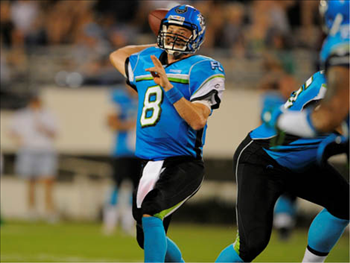
Of course, the downside is that we’d be over-saturating the talent pool a bit—look at the rosters in the United Football League (UFL) and it wouldn’t be surprising to wonder, “Quinn Gray? Isn’t he dead? I thought he died in 2002. Weird.” And the UFL kind of already has a leg up as far as goofy names and logos (although I’m sure you get lots of street cred for wearing a light blue Florida Tuskers cap in downtown Tallahassee these days).
But I still think that more football can’t help but be fun to watch, especially if we know that it means something (with apologies to the UFL’s championship game, the aptly-named UFL Championship Game…that took some marketing genius). We’d get to see some college stars sharpen their skills before getting tossed into the fires of the NFL. We’d get to see more of the 2009 UFL MVP, Brooks Bollinger, and who wouldn’t want that?
Seriously though, minor league football is an idea waiting to be realized. I just hope I’m given the proper credit when the time comes.

What, Too Soon For A Team To Be Called The New Orleans Hurricanes?
Speaking of team names, and speaking of MLS, I realized something while watching the MLS All-Star Game this week. And no, my realization was not overwhelming shame brought on by watching the MLS All-Star Game.
As the announcers desperately tried to sell the viewers on the merits of MLS, they would talk about the various teams in the league. At some point, I realized that two of the teams are named after natural disasters that happened in that city. The first one I noticed was the Chicago Fire, which I’ll grant is a cool name, and since the Great Chicago Fire happened nearly 140 years ago, I think it’s a safe enough reference to make.
But I couldn’t help but Tweet my reaction, and the follow up thoughts about teams and names that reference disasters. Ever full of sarcasm and wit, I wondered if we would see the San Francisco Earthquakes, or the Seattle Volcanoes, or the Louisiana Flood.
Turns out, as I watched more of the telecast, there actually is a team in MLS called the San Jose Earthquakes.

For one thing, I think a single earthquake is scary enough, but to have to face a team full of earthquakes…that is a contest I’m not prepared to undertake.
Is it just me, or is it a little odd that a team can be named after a disaster that happened just 21 years ago? I remember the San Francisco earthquake of 1989, mostly because it interrupted the World Series, but I still have clear mental pictures of collapsed bridges, chunks of highway uprooted and buildings falling over. This wasn’t that long ago, but it’s open for a team to be named after it?
My Tweets carry over to Facebook, so I ended up in a bit of a discussion about this phenomenon that circled back to listing a whole lot of borderline-inappropriate team names that MLS should consider. Some of the gems include the Oklahoma Cyclones, the Buffalo Blizzard (an actual team in the now-defunct National Professional Soccer League),
the Kansas Dustbowls, the South Carolina Confederates, the Dallas Grassy Knolls, and my personal favorite (courtesy of my friend Rick), the Pearl Harbor Attack.
Just to be clear, none of this is meant in a mean spirit or anything—the point is that if it’s OK to have a team named the San Jose Earthquakes just 21 years after the actual earthquake, where do we draw the line?
I’d like to further explain myself by saying that I honestly have no opinion on the matter, I just happened to find it interesting that a team/league would step out and make a decision like this. I don’t have a problem with it—to me, it’s just a team name, and should therefore be taken as such. I could write a whole lot of pages about my thoughts on people who take themselves and everything else too seriously, but I’ll save that for another time.
I guess my curiosity is such that I wonder why a team would even bother to tempt it by using a name that could have any potential negative connotation? On the other hand, part of me wants to congratulate them for taking that kind of a stand, because, as I said, it’s just a team name, and honestly, why should it be taken as anything more? It’s an interesting situation, that’s for sure.
And as I said before, if you have any thoughts on the subject, please e-mail me at sports@valleycenter.com and I’ll be sure to share what you have to say with our readers.
Just be sure to send it in right away, because (as Target keeps reminding me) summer is almost over, and the sports pages will soon be filled with all the football that’s fit to print once again!